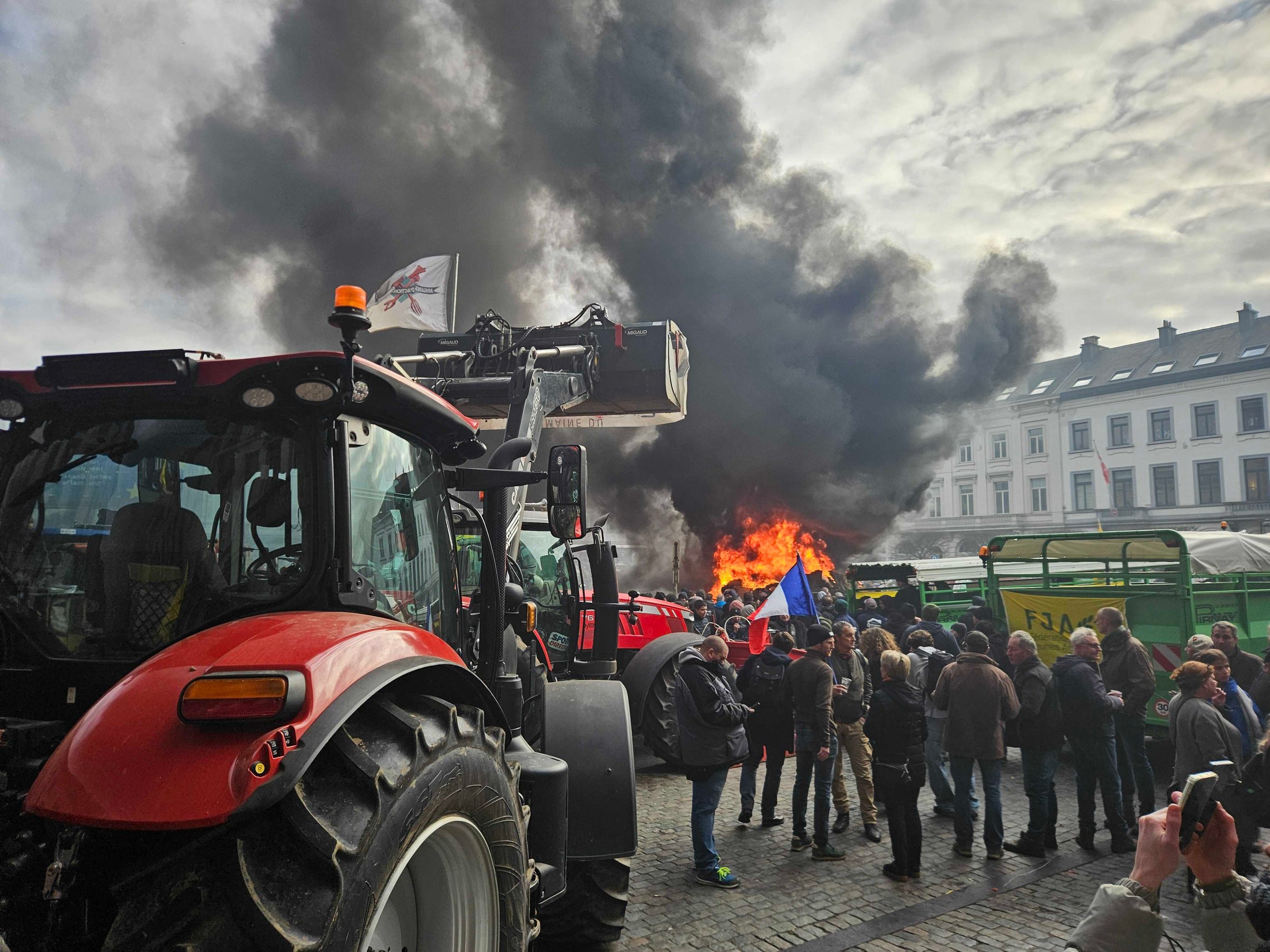
MEPs have agreed a series of guarantees designed to ensure that the EU Commission will suspend farming imports under its controversial new Mercosur trade deal with South America if there is evidence that they are damaging European farmers’ business.
The guarantees, backed by a 483 to 102 margin, set out a series of ways under which the commission can temporarily suspend free trade in agricultural imports from the six South American states in the Mercosur trade bloc if there is evidence that they are hurting European producers.
The new safeguards law introduces a “presumption of harm’ in cases where imports are at least five percent cheaper than European prices over a three-year average.
In this circumstance, the commission would be required to launch an investigation and make a decision on suspending duty and quota-free trade.
Meanwhile, the EU executive will also be required to conduct what Spanish conservative MEP Gabriel Mato, the parliament’s lead negotiator on Mercosur, described as “permanent and constant monitoring” of import volumes and prices.
Mato told reporters in Strasbourg on Tuesday (10 February) that the vote was about “reassuring the farming community” and ensuring that MEPs “lived up to their responsibility to farmers”.
Mato told reporters that the commission would be forced to step in and that “intervention become not just an option but an obligation” for the EU executive.
He added that the commission had also promised to open negotiations on full alignment on phytosanitary and other farming production standards, including the use of pesticides.
“Demanding strict reciprocal rules is not protectionism,” said Mato, adding that the safeguards provisions would ensure that “European farmers will be better protected”.
The safeguards law is in addition to guarantees of billions of euros in financial support for European farmers affected by trade from Mercosur.
After the French government announced that it would increase import checks at its ports to guard against imported products containing banned pesticides, the commission announced in January that it would increase EU funding for a 50-percent increase in audit checks.
These measures have all been criticised by Argentinian president Javier Milei but have been accepted by Mercosur leaders as the price of getting the trade pact over the line.
Angry farmers
The farming lobby has emerged as the main critical constituency of the Mercosur trade deal.
Last month, MEPs narrowly backed a resolution to refer the draft agreement to the European Court of Justice for a legal opinion of its conformity with EU law.
Though a handful of EU states, including France, Ireland and Hungary, oppose the Mercosur deal, most governments are anxious for it to enter into force as soon as possible.
Following the parliament’s ECJ referral, widely seen as a delaying tactic by opponents of the Mercosur agreement, they have urged the commission to provisionally apply the agreement — a move which is allowed by the EU treaties, pending ratification by the EU parliament.
The million dollar question is whether the safeguards will be enough to placate the farming lobby and to corral a majority of MEPs to ratify the Mercosur deal when it comes back from the ECJ.
The Luxembourg-based court is widely expected to confirm the legality of the agreement.
Mato conceded that the safeguards deal could pave the way for the Mercosur deal to be provisionally applied, though he warned the commission against ‘sidelining’ MEPs.

 Russia is likely preparing for a massive autumn mobilisation of over a million soldiers (Ukraine Battlefield update, Day 1,589)
 Benjamin Fox