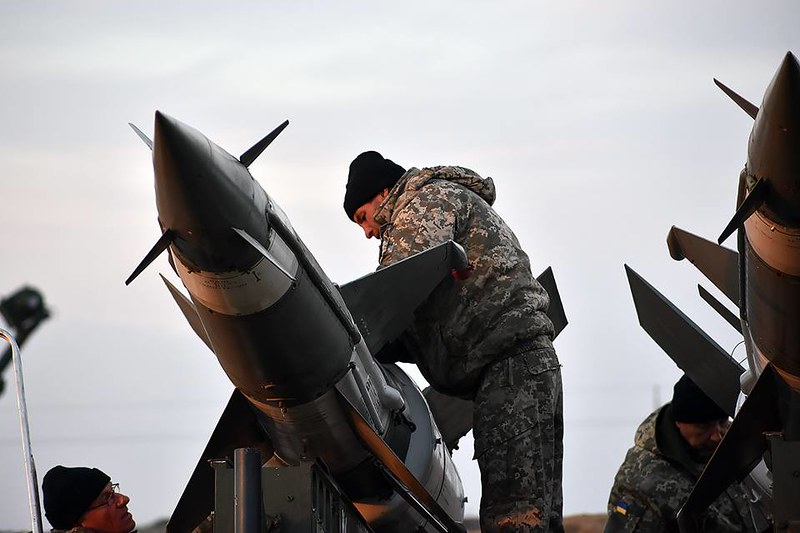
Ukraine will set up 10 export hubs across Europe to sell surplus military equipment produced by domestic firms.
The move could allow Ukrainian manufacturers to scale production and capture a share of the sky-high profits enjoyed by European arms makers, potentially creating a new source of revenue for Ukraine’s wartime economy.
According to president Volodymyr Zelensky’s remarks on Monday (9 February) at the Kyiv Aviation Institute, the centres will be located in northern Europe as well as the Baltic states.
Since the start of Russia’s full-scale invasion of Ukraine in February 2022, European weapons producers, such as Rheinmetall and Helsing, have enjoyed a surging high of profits and soaring valuations, fuelled by rearmament efforts across the continent, amid concerns that Russia could attack other countries.
Last week, Czech arms maker CSG completed the biggest initial public offering in defence-industry history, making its owner, Michal Strnad, the richest man in Central and Eastern Europe.
The European Union last year introduced the Security Action for Europe (SAFE) program, designed to provide financial support to member states to accelerate defence readiness by enabling urgent and major investments. Ukraine can participate as a partner in joint procurement projects conducted by EU member states under SAFE.
Ukrainian officials and defence industry have actively pitched Ukrainian firms’ capacity in ammunition, FPV (first-person view) drones, drones with extended range, and missile systems as contributions to EU joint-procurement projects.
Countries set to receive funding include Belgium, Bulgaria, Cyprus, Denmark, Spain, Croatia, Portugal, and Romania, with combined project values running into tens of billions of euros.
For example, Romania alone is slated to receive more than €16.6bn, while Belgium’s allocation tops €8.3bn.
A second group of eight national plans — including those from Poland, Italy, and Finland — has cleared a procedural hurdle in Brussels and is on track for formal approval by EU ministers on 17 February.
Export controls and profit caps hold firms back
Ukraine’s defence sector has also expanded rapidly. It reached a production value of $10bn (€8.4bn) in 2024 and is projected to grow to $15bn in 2025, according to a report published in July by the Kyiv School of Economics Institute.
Military production is now on par with agriculture, one of the country’s traditional economic pillars, accounting for seven percent of Ukraine’s GDP.
Around 450 companies are currently producing drones in Ukraine, 40 to 50 of which are considered industry leaders.
Yet compared with their European counterparts, that output is modest. Domestic producers in Ukraine have been constrained by export controls, leaving many manufacturers almost entirely dependent on state orders during wartime.
In addition, the government introduced profit caps of 25 percent in an effort to procure sufficient quantities of affordable weapons.
These constraints have long been accompanied by complaints from the arms industry that it could produce far more equipment than the government can afford to buy.
Allowing Ukrainian firms to expand abroad should help them secure long-term projects, provide greater financial stability, and protect them from downtime and drying cash flow, as they cannot afford to lose their engineering teams.
Serial production would lower unit costs, weapons could be updated more quickly, and the country would receive more tax revenue and technology inflows.
Europe, for its part, would gain access to high-tech, battle-tested technologies that Ukraine has developed over four grueling years of war.
However, this benefit comes with the risk that Ukrainian innovations and technologies could leak to the enemy.
Zelensky’s shift on arms exports
This concern is one of the reasons Zelensky has been cautious about opening foreign markets to domestic companies. In October 2024, he ruled out such a move because of the risk that technology could reach the Russian Federation, but instructed then–defence minister Rustem Umerov to develop models for selling Ukrainian UAVs abroad, according to the news website Dengi.
In October 2024, Zelensky told Ukrainian TV that the exports would be possible only to Ukraine’s allies in the Ramstein group, which coordinates military support for Kyiv, Reuters reported.
In 2025, the president’s rhetoric began to shift. In June, he announced the first agreements with partners under the ‘Build with Ukraine’ programme, which involves exporting military technologies and opening production facilities abroad.
In September 2025, Zelensky continued to advance the initiative, announcing the possibility of controlled exports of surplus weapons to partners. In November, the commander-in-chief said that by the end of the year Ukraine would open two export offices, in Berlin and Copenhagen.
According to Umerov, now secretary of the national security and defence council, the first real contracts are expected in the second half of 2026, the Ukrainian website Dengi reported.
Additionally, Zelensky also announced on Monday that drone production in Germany will begin in mid-February.
“This is a fully operational production line. In the U.K., similar production lines are already running. These are all Ukrainian technologies,” he wrote on Telegram.
This story is a part of the weekly newsletter about economy, defense and tech in the Eastern flank of Nato, How we cee it.
 THIS WEEK: ECB set to hike rates, as capital markets union and climate top the EU agenda


 Shocked Russians watched worst attack on Moscow since the start of war (Ukraine Battlefield update, Day 1,575)