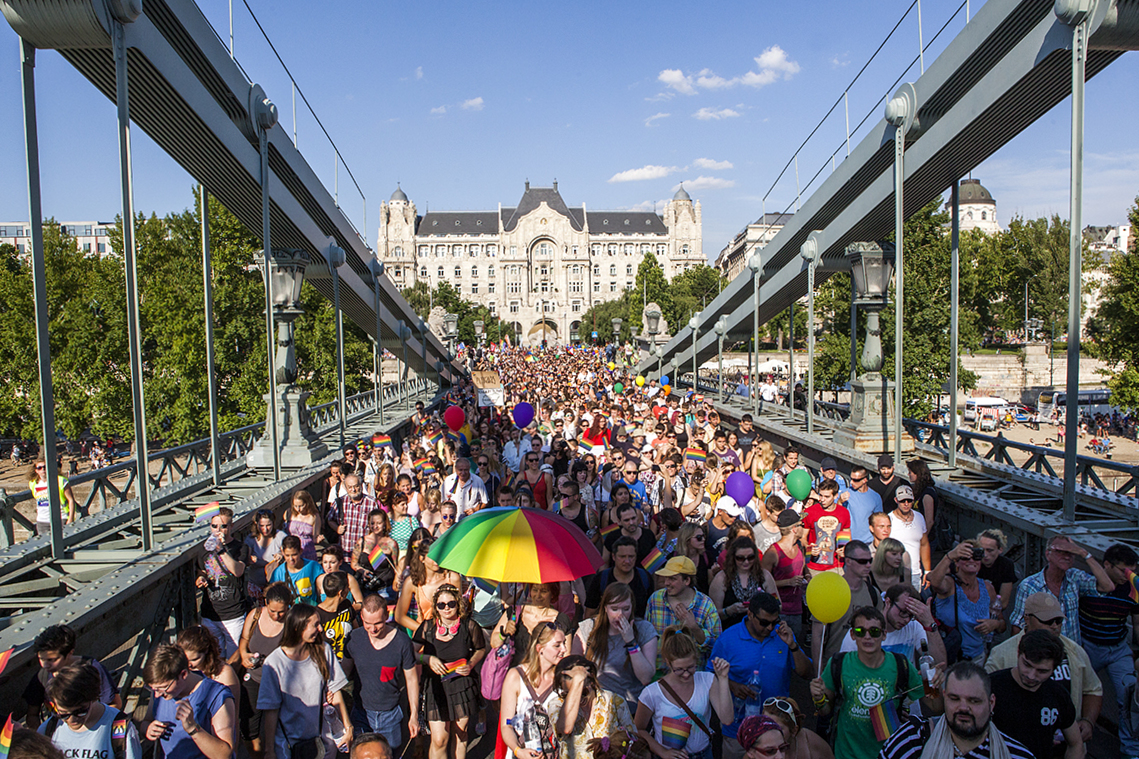
This year, Hungarians can celebrate Pride openly. For the first time in history, there are rainbow flags on the streets and bridges of the Hungarian capital.
The police have officially acknowledged this year’s Budapest Pride march on Saturday (27 June), marking a sharp departure from the previous government’s hostility. After years of attacks on LGBTQIA+ people and on the freedom of assembly, this change matters. It deserves recognition.
Yet celebration cannot obscure the central challenge. The laws that criminalise Pride participation and enable biometric surveillance of protesters remain in force.
The question now is whether Péter Magyar’s new government will turn its public support for Pride into legal reform by dismantling the anti-Pride infrastructure inherited from Orbán.
In March 2025, the Orbán government rushed through amendments classifying Pride participation as a minor offence. They also expanded facial recognition to cover all petty offences, allowing the police to identify march participants.
The public response was overwhelming. Hundreds of thousands of people rejected the government’s attempt to push LGBTQIA+ people out of public life.
Due to the huge turnout at last year’s Pride, no minor offence proceedings were initiated against the participants. However, criminal proceedings were launched against the organisers, among others the mayor of Budapest.
Even though the law was not enforced, large trucks equipped with biometric cameras were stationed around the Pride march to discourage participation.
The objective was not only punishment, but deterrence. This logic remains embedded in Hungarian law today.
The new government’s public support for Pride and the LGBTQIA+ community is a positive step. However, the previous restrictive laws remain in effect. Their repeal is a priority for democratic restoration.
Accordingly, civil society organisations sent a letter urging immediate action by the new government and parliamentary committees to eliminate anti-LGBTQIA+ amendments, restore freedom of assembly, and launch a public consultation on biometric surveillance.
These demands go beyond strictly LGBTQIA+ rights, aiming to restore the rule of law in the country.
One alarming aspect of the 2025 law was expanding facial recognition to all petty offences. This raises profound concerns for democracy. Facial recognition in public spaces allows authorities to track people without their knowledge. At protests, it chills participation; people may stay away for fear of being identified, recorded, and sanctioned.
This is precisely why the European Union adopted strict prohibitions in the Artificial Intelligence Act. Article 5 of the AI Act prohibits the use of real-time remote biometric identification systems in publicly accessible spaces for law enforcement purposes except in narrowly defined and exceptional circumstances.
'Real-time' surveillance?
These prohibitions were put in place because they reflect a common societal agreement: that mass, real-time biometric surveillance is incompatible with a democratic society.
Civil society, legal experts, and digital rights advocates have argued that Hungary's legislation violates these prohibitions.
While Hungarian authorities claim their system is not "real-time," legal analysis by the Hungarian Civil Liberties Union, ECNL, Liberties, and EDRi explains why this distinction is misleading.
Under the AI Act, systems that identify individuals after brief delays can still qualify as real-time remote biometric identification. The key issue is not instant identification, but whether it happens quickly enough to influence behaviour in public spaces.
This analysis finds Hungary's facial recognition framework is designed for that purpose.
Yet despite repeated warnings from civil society and legal experts, the European Commission has so far failed to take decisive action against the Hungarian government that passed laws enabling such practices.
Organisations across Europe have urged the commission to assess Hungary's (still existing) legislation under the AI Act and to initiate infringement proceedings where necessary. They have argued that the Hungarian framework not only threatens freedom of assembly and privacy but may also directly conflict with European law.
But the EU Commission and its AI Office have been slow and opaque in their assessment - to this day we do not know the results.
The commission's hesitation matters because the AI Act was meant as a global standard for trustworthy AI. If the EU does not enforce its own rules when a member state uses biometric surveillance against peaceful protesters, these protections become only theoretical.
This ongoing uncertainty around Hungary’s surveillance laws reinforces the urgent need for legislative reform to protect freedoms and restore democratic norms.
The previous government’s surveillance should not remain in place simply because AI Act enforcement lags at the EU and national levels. Lack of oversight isn’t a reason to wait; it is a reason to speed up reform.
In light of these urgent concerns, the newly-elected Tisza government must act now: withdraw the anti-Pride amendments and remove the legal basis for biometric identification of participants in peaceful assemblies. This concrete legislative action is essential to protect rights and freedoms.
The commission should act on civil society’s complaints and check if Hungary’s biometric surveillance complies with the AI Act. With national enforcement trailing, EU oversight is more vital than ever. Decisive action by the commission would set a European blueprint for rights protections.
Last year’s Pride march in Budapest demonstrated what is possible when citizens defend their freedoms, and this year’s decriminalisation is a reason for happiness.
But legal recognition of one event is not enough. The laws that still enable mass surveillance and targeting of peaceful demonstrators must be repealed, and the safeguards promised by European law must be enforced in practice.









 Europe’s ugly anti‑migrant politics just found a new stage: South Africa