First published in Respekt magazine.
Birth rates are falling sharply across Europe and the entire developed world. Elsewhere too, politicians and demographers are grappling with why some people do not want to have children and others, even if they would like to, simply do not have them.
In countries like the Czech Republic, politicians, whether in government or opposition, periodically sound the alarm and propose — and sometimes actually introduce — all sorts of measures, ranging from increasing parental allowances to extreme (and still ineffective) family policies modelled on Viktor Orbán’s Hungary, where the emphasis from school onwards is on the “traditional family” and on the continuation of the ethnically Hungarian nation, and young couples receive advantageous loans or benefits.
And however deeply personal the decision to start a family or raise a child may be, a “shortage” of children logically shakes the whole of society. The modern welfare state functions only if it has enough young taxpayers — who contribute not only to pensions, but also to healthcare, the police or, for example, road repairs.
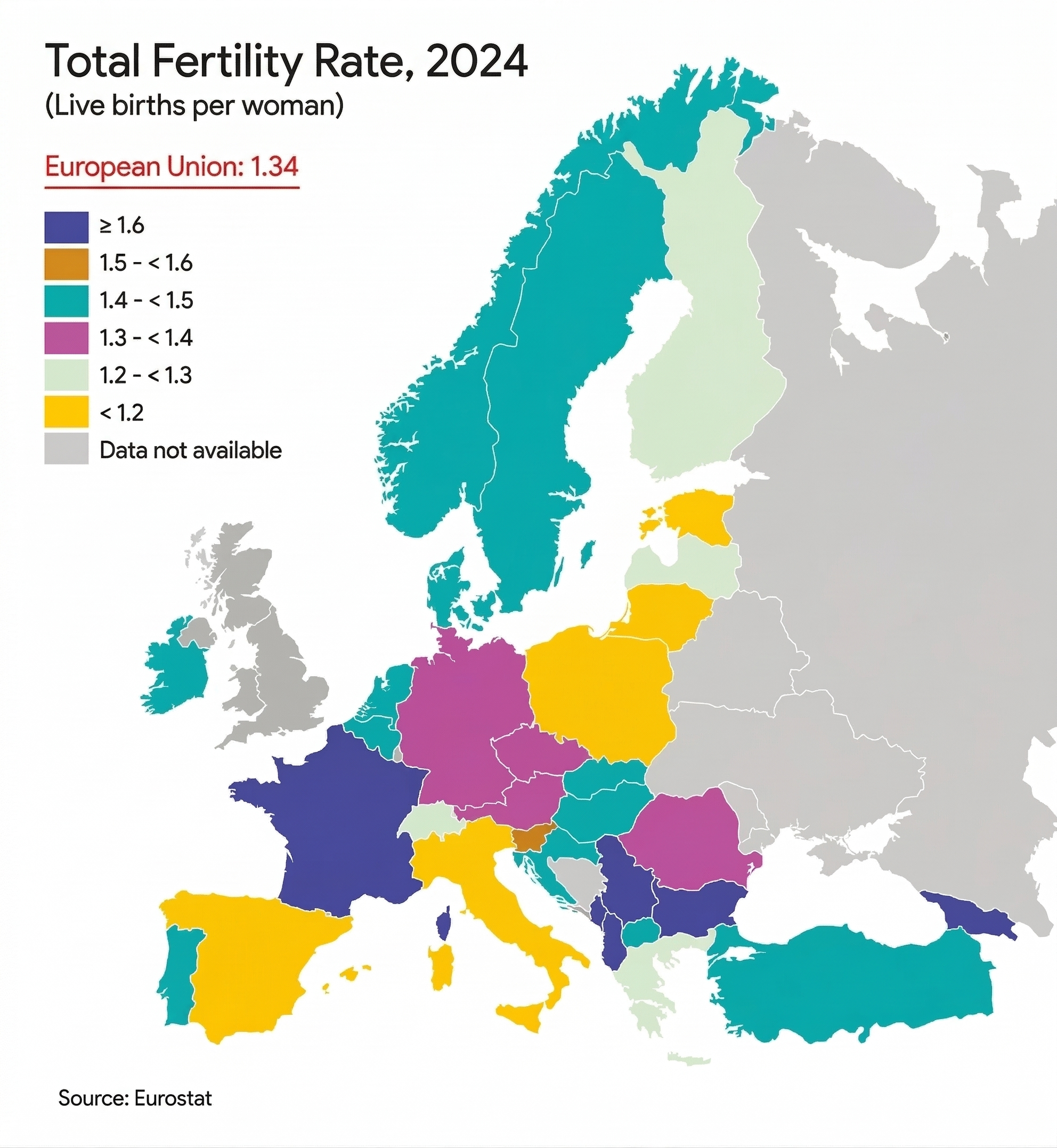
According to demographers, for the system to work it is essential that 2.1 children are born per woman.
In 2024, almost half (49.8 percent) of familis with children in the EU had one child, 37.6 percent had two children, and only 12.6 percent had three or more children, according to data from Eurostat.
Everyone can see that the situation is unsustainable.
So why are today’s young people not having children, and what can be done about it?
Being the kind of parent you want to be
For a long time, the Nordic countries and their generous welfare states were held up as examples for Europe. Raising a child, let alone several, is expensive and demanding, and there is broad agreement that public support plays a crucial role.
“We know that benefits for new parents, and above all accessible childcare, lead to higher birth rates,” said Finnish demographer Anna Rotkirch, head of research at the Family Federation of Finland at the Population Research Institute.
She added that this was by no means only about the Nordic countries. The benefits of accessible childcare, meaning nurseries and kindergartens, are confirmed by data from a number of studies.
One of them is last year’s study by the prestigious independent US-based Institute for Family Studies, which compares state investments across Europe and the United States.
According to the study, cutting the generosity of programmes leads to a decline in birth rates — and increasing them leads to a rise. The data show a very clear correlation.
As a general rule, an increase in benefits equivalent to four percent of GDP per capita per child is associated with a one-percent increase in the probability of a birth.
This refers to maternity or parental leave, tax advantages for parents, or a one-off state payment for the first and subsequent child, known as a birth grant.
However, such investments are extremely costly and, according to some experts, produce problematic results, because they persuade only a small fraction of the undecided to start a family.
If, however, the state is willing to invest in children at all costs (because it simply has to), it does achieve some results.
Researchers at the University of Oslo reached a similar conclusion in a 2021 study, but they also focused on where exactly the state invests the money. Instead of straightforward cash transfers (benefits), they found that expanding the supply of childcare works better. And the reason is obvious.
“Accessible childcare is essential nowadays. Even if some people would like to return to a time when women stayed at home and men worked, today the economic situation no longer allows that. Two incomes are necessary to run a household,” Rotkirch stressed.
Mothers who, due to a lack of nurseries or kindergartens, cannot return to work or who, after a long break, come back to a worse or lower-paid position and thus disrupt their career, then naturally think even harder about whether to have any more children after the first.
Rotkirch said that the above did not mean that anyone should force women to work immediately after giving birth. It is about much more: the state should make it easier for parents to be the kind of parents they themselves wish to be. This is supported, for example, by data from France, which until recently could boast a relatively high number of newborn children.
“We know that the more unequal a society is, the more childcare falls solely on mothers and the harder it is for them to return to work, the lower the birth rate is in developed countries,” described another aspect Gilles Pison from the National Museum of Natural History.
German demographer Paul Riesenhuber from the Berlin Institute for Population and Development agreed.
“Today’s world is full of uncertainty. Young people are grappling with climate change, a lack of housing, wars and economic crises. All of this makes them think very carefully about whether they want to have children.”
Moreover, national governments can do little about many global phenomena. That is precisely why it is important for politicians to support parents where they can, and publicly funded institutional childcare from the first year of life is, in his view, the top priority.
The Nordic paradox
The fact is that today even the long-admired Nordic model has stopped working.
Over roughly the past decade, birth rates in these countries have also begun to plummet, despite accessible childcare and generous social benefits.
Pieter Vanhuysse from the Danish Centre for Advanced Study offers extensive research from 12 countries that shows why.
“All this time we have been looking only at a small piece of the puzzle — namely, at where state money is flowing. But the other two streams of investment in child-rearing are much more important,” he explained.
“The first of these is the costs borne by parents themselves — how much a child costs them from nappies to university tuition fees. And the second is the time and energy they invest in their children.”


![As birthrates decline and the workforce empties out, “in some countries, [people] are obliged to retire,”](https://static.euobserver.com/2005/04/677e4ac7c530bd9e00eb0ac007326e19.jpg)

 Dominika Perlínová