Plastic products in the European Union may soon be labelled as “recycled” even if they contain only a tiny fraction of plastic waste.
Under a definition recently adopted by the European Commission with the backing of 20 member states, new plastic could qualify as recycled with as little as 2.5 percent material derived from waste.
The decision comes as the chemical recycling industry — strongly promoted by plastics and oil companies — faces growing doubts about its real-world performance.
Meanwhile, of the 78 recycling plants previously announced across Europe, only 18 appear to be operating today, and none of them has disclosed how much recycled material they actually produce.
Chemical recycling differs from conventional mechanical recycling by breaking plastic waste down into chemical components, typically using pyrolysis, a process that heats plastic without oxygen.
The resulting pyrolysis oil can theoretically be used as a raw material for new plastics.
In practice, however, only small amounts can be mixed into production because the oil is highly corrosive, meaning that the final plastic products are still overwhelmingly made from new fossil-based materials.
Speaking at a conference in Brussels organised by the French Petroleum Institute (IFPEN) last November, a spokesperson for the industry group Plastics Europe admitted that recycled material will make up only a small share of production.
In the early stages, he said, around five percent of the feedstock will come from recycled plastic, while about 95 percent will still be conventional fossil-based naphtha, possibly even more.
240,000 tonnes of plastic waste
In reality, even five percent is likely an overestimate.
When pyrolysis oil is processed in a steam cracker, only about 40–50 percent becomes monomers — the basic chemical building blocks used to make plastics. As a result, the share of recycled material in the final plastic product drops further, meaning it would contain around 97.5 percent new, “virgin” fossil-based oil.
Companies involved in chemical recycling have been asked to comment on these figures, but few have responded. Of the 18 chemical plastic recycling plants operating today, none have been willing or able to disclose how much pyrolysis oil they actually produce, or how their operations reduce CO₂ emissions from plastic manufacturing.
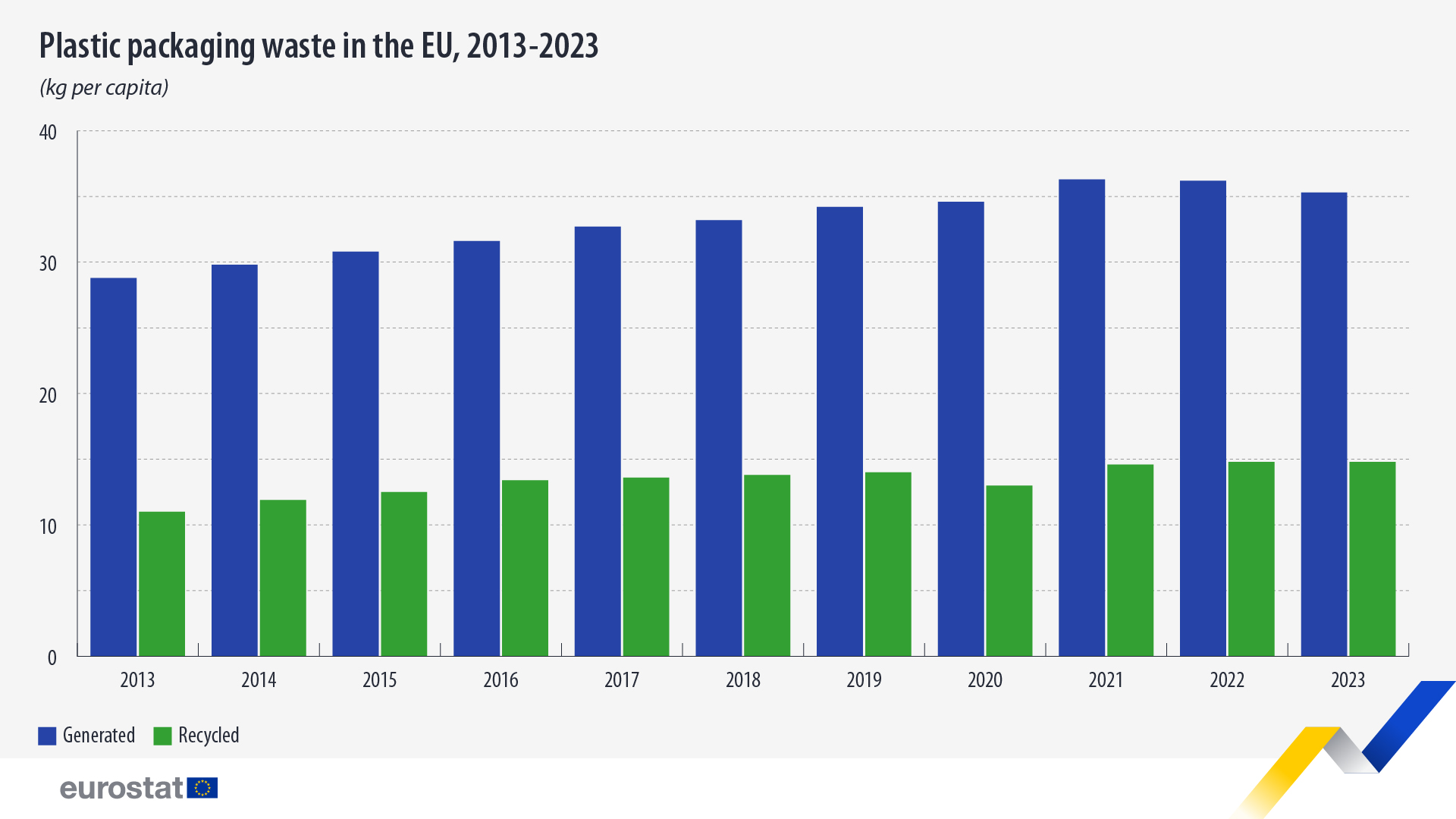
One figure that is partly available concerns the amount of plastic waste the 78 planned facilities said they would recycle: 2.9 million tonnes, compared with roughly 26 million tonnes of plastic waste generated in the EU each year.
When the reported input figures from the 18 more-or-less operational plants are added together, the total amounts to about 240,000 tonnes of plastic waste — only around nine percent of the capacity originally promised.
These figures are confirmed by a statement from the industry organisation Plastic Recyclers Europe.
A pessimistic overview from the organisation last year stated: “Preliminary data for 2025 shows a 50-percent increase in the closure of recycling plants, resulting in a loss of one million tonnes of European recycling capacity in just three years.”
“Most of the pyrolysis plants […] I have seen over the past 25 years have failed or stalled, and there are virtually no large, proven plants. After decades of failure, we must ask ourselves why this path is still being promoted,” comments Stefano Consonni, professor at the Department of Energy at Politecnico di Milano.
Behind the growth in oil-extraction
Despite producing only small amounts of recycled material in the final products, and despite the fact that few of the planned facilities have managed to operate on a commercial scale, the industry still presents chemical recycling as the way forward.
The reason can be found in an analysis by the International Energy Agency (IEA). “The increasing use of oil products as raw materials for the production of plastics and synthetic fibres cemented the petrochemical industry’s dominance of total oil demand growth in 2024, accounting for around three-quarters of net growth,” the IEA noted in its Oil 2025 report.
“Industry and oil-producing states are pushing for chemical recycling to maintain growth in plastics,” comments Lee Bell, technical and policy advisor at the NGO International Pollutants Elimination Network (IPEN).
Oil as a raw material for plastics is not only the main driver of growth in oil exploitation. Several oil companies are themselves directly involved in plastics production, for example, SABIC, a subsidiary of the Saudi oil company Aramco.
The Riyadh-based plastics manufacturer has entered into several agreements to supply packaging for well-known consumer products such as Magnum ice cream, Kind chocolate, Philadelphia cheese, and Garofalo pasta.
The packaging for these products is labelled with texts such as “certified renewable polymer, recycled plastic” or similar, in accordance with SABIC’s own TRUCIRCLE label. Their goal is reportedly “to recycle plastic into high-quality products and help prevent valuable used plastic from becoming waste.”
A mathematical assumption
The industry’s definition of recycled plastic is based on the concept of mass balance.
The idea dates back to the early days of chemistry in the 18th century, when the French scientist Antoine Lavoisier formulated the law of conservation of mass: matter is neither created nor destroyed in chemical reactions, but simply changes form.
Applied as an accounting method in modern plastic production, this principle allows manufacturers to allocate recycled content mathematically across their output. As a result, plastic products can be labelled as recycled even if they contain only a small fraction of material derived from waste.

 THIS WEEK: ECB set to hike rates, as capital markets union and climate top the EU agenda
 Why blocking the sun to cool the planet is bound to go wrong