With gas prices rising as a consequence of the Israeli-US attack on Iran, talk of interest rate hikes in Europe returns.
Europe’s main gas price benchmark has nearly doubled since attacks started on Friday.
Reacting to gas market turmoil on Monday, German conservative MEP and inflation hawk Markus Ferber warned that conflict in Iran could trigger another energy crisis and called on the European Central Bank to “stay vigilant.”
ECB’s chief economist Philipp Lane then told the Financial Times on Tuesday that for now he does not see a reason to change central bank rates but promised to “closely monitor developments.”
Having covered the 2021-2023 energy crisis closely, it’s worth revisiting what actually occurred during that episode.
We know energy price shocks can quickly spread through the economy. The question is whether the ECB is well positioned to deal with the effects of energy price spikes.
By its own admission, it isn’t.
Inflation-fighting measures that worked in 2021–2023 were fiscal — and included tax cuts, subsidies, and gas storage targets — not monetary.
The rate discussions that emerged this week picked up right where the rate hikes of 2022-2023 left off, making it worth revisiting how the ECB’s energy-crisis policies played out at the time, and what lessons we might draw from them.
Inflation shocks and spillovers
First, some explanation about the perceived need for rate increases. It's true that rate-hikes guard against so-called 'spillover' effects of inflation from energy shocks into wages and broader prices, but data on their effectiveness is choppy.
It is inherently difficult to “pin down causal relations” in macroeconomic models, resulting in a “wide range of estimates” of the impact of monetary policy on the economy, Lane said in a lecture in 2023 reflecting on the impact of interest rates.
The ECB put the impact of the rate hikes on inflation at 1.2 percentage points in 2023, and 1.8 percentage points in 2024 (with GDP growth around 1.5 points lower on average over the three years).
But ECB modellers project such “astonishingly wide,” range of real-world outcomes of their policies, that financial historian Adam Tooze described it at the time as “essentially an admission of ignorance.”
It could be that inflation would have been worse without higher rates.
But rate hikes typically work with a 12–18 month lag, meaning their effects only kicked in after the crisis was largely over.
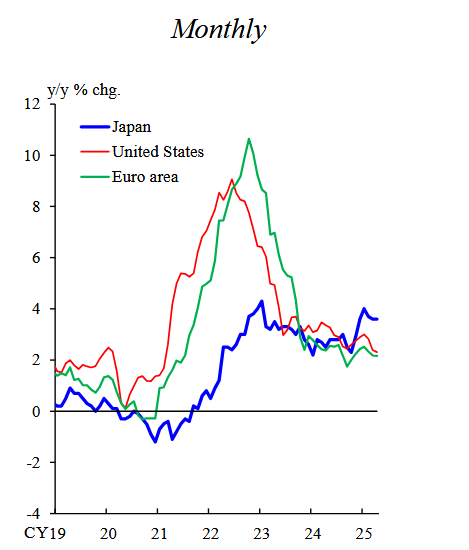
That may help explain why inflation trajectories in Europe, the United States and Japan were broadly similar during those years, even though monetary policies differed sharply.
Japan maintained a negative interest rate from 2016 until 2024, calling into question the impact of rate hikes on energy price inflation.
What’s more: the ECB long ignored the most important spillover effect of the energy crisis: corporate profiteering, especially that of oil and gas companies such as Shell and Exxon which posted their highest ever profits in 2022.
ECB president Christine Lagarde later admitted in 2023 that corporate profits “contributed around two-thirds to domestic inflation,” more than twice the usual level, which resulted in a “large real-wage decline” even though monetary policy was designed to guard against wages driving up prices, a so-called “wage-price spiral” which, the OECD later found, never materialised.
“The contribution of profits to inflation has gone a little bit missing. We don’t have as much and as good data on profit as we do on wages,” she later told the EU Parliament.
Since then, the ECB has done some work on profit monitoring, but it has not set up a broad, systematic public programme comparable to wage and cost indicators.
As economist Isabella Weber noted on social media on Tuesday, fossil fuel stocks are once again “exploding” in response to the war in Iran.
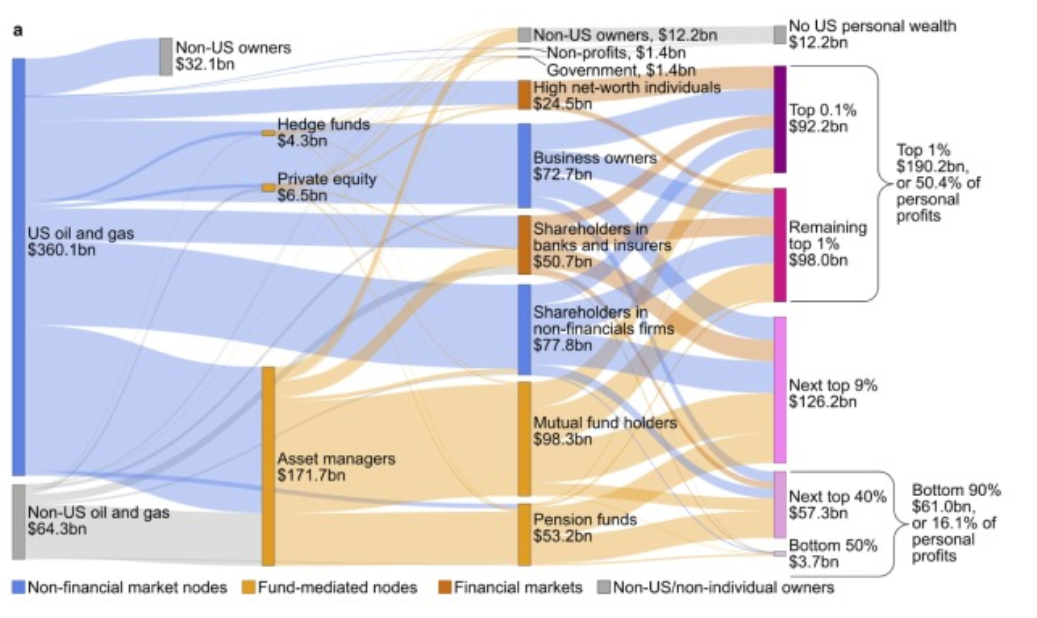
And in a recent research paper co-written with Gregor Semieniuk, also a professor at the University of Massachusetts Amherst, she found US fossil fuel companies gained the most from the 2022 energy crisis and that profits “almost exclusively benefited the top wealth owners.”
And as she recounted in a speech at the Heinrich Böll Stiftung in 2023 the crisis presented companies with a “perverse window of opportunity", enabling them to raise prices above what was needed to cover higher costs without customers noticing.
Corporate price gouging, or ‘sellers-inflation’ as Weber calls it, was a core cause of the 2022 cost-of-living crisis, which saw real wages plummet across Europe and the United States.
But in Brussels, the first response this week was not concern about profits, but rising wages. Ferber, the European People’s Party (EPP) economic spokesperson, warned on Monday that "wage setting" posed a "key risk" to inflation as news of the Iran conflict emerged.
Excessive corporate profits went unmentioned in his call for the ECB to remain vigilant.
High rates delay decarbonisation
The ECB itself has repeatedly said over the years that its policies are ineffective when dealing with energy shocks.
Italian central banker Fabio Panetta for example said in 2023 that the ECB “cannot do much against inflation triggered by a supply shock,” which includes imported energy. “Monetary policy only influences [domestic] demand.”
The 2022-23 interest rate hikes of 4.5 percentage points did cause delay to the energy transition, because they made renewables more expensive
Precise data on the scale of the impact remains limited.
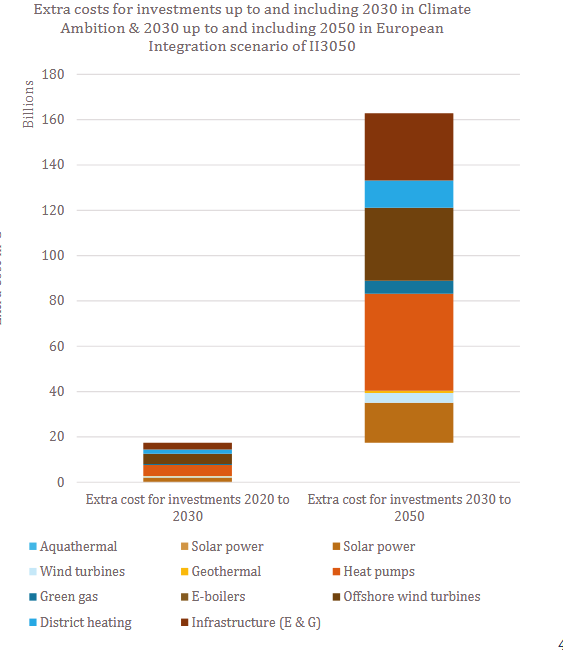
But in the Netherlands, for example, analysts estimated that higher interest rates added tens of billions in additional costs to the energy transition by 2030 across eight major climate technologies, including solar, wind, and geothermal – over €200bn until 2050.
Raising rates “poses a long-term risk for the energy transition because we know that under these circumstances, investments will simply not be made,” Carsten Brzeski, chief economist of ING Germany, told EUobserver in 2023. “I could make a good case to take it easy for a while.”
A year later, in 2024, the now former Ørsted boss Mads Nipper warned that continued elevated interest rates were disproportionately hurting renewables, which require more upfront payment – especially offshore wind — slowing renewable deployment. We all know how that went.
This should give inflation-fighters pause, because renewables reduce inflation. The IEA estimated that 2021-2023 solar and wind additions shaved €100bn off consumer power bills during the energy crisis across Europe, in effect stabilising prices.
But the annual State’s of Europe Climate Investment report published by the Paris-based non-profit Institute for Climate Economics found that "after years of strong growth" green investment growth plateaued after 2023.
Interest rates are only part of the story of why Europe’s decarbonisation slowed down after the energy crisis. Many of Europe's policies are ineffective in actually reducing oil and gas use.
Still, with gas prices surging again this week, raising rates should be the last thing on policymakers’ minds. Higher rates would hit clean energy investment hardest, delaying decarbonisation and leaving Europe more exposed to future energy price shocks.
And as ECB president Lagarde said at an event in September 2023: "Procrastinating is likely to increase the bill we will end up having to pay.”
Are we OK?
For now, Lane told the FT that he does not see any reason to change the ECB's main interest rate: “I think where we are now is OK.”
But rates should not be thought of as an effective tool during supply shocks; they are untargeted, come at "massive" societal cost, and there are less costly alternatives, such as stockpiling essential goods and public price monitoring, as economists Weber and Jens van ‘t Klooster argued in a 2024 paper for the EU Parliament's economy committee.
The European Commission did set gas storage targets after the energy crisis, but as prices fell, some member states, including France and Germany, eased the rules.
In part because of that, Europe now enters the Iran-crisis with depleted gas buffers. Storage stood at 46 billion cubic metres (bcm) at the end of February 2026, down from 60 bcm in 2025 and 77 bcm in 2024.
If energy is the problem, nobel-prize winning economist Joseph Stiglitz told EUobserver in 2023, the focus should be on facilitating “the entry of new clean-energy firms, not making it harder for them to compete with entrenched fossil-fuel companies by increasing borrowing costs.”
Just to put a number on it, the EIA estimated in 2023 that clean energy investments could save $12 trillion [€10.4 trillion] in global fuel costs by 2050 — slashing overall energy bills and helping to stabilise energy prices (and thus inflation) for decades.
Even if rates do eventually rise because prices start to rise across the economy and pressure on the ECB to display its “commitment” to return to more stable market conditions becomes irresistible, there are tools the ECB could use to shield inflation-lowering green investments from higher borrowing costs, as economists told EUobserver already back in 2021.
Such measures are politically contentious, as they risk the ECB being seen to 'pick winners'.
Even so, such safeguards should be explored to prevent future fossil-fuel shocks and rate hikes from undermining the green transition — shocks that are bound to keep occurring as long as Europe depends on imported fossil fuels, as Pauline Heinrichs, war studies lecturer at King’s College said in a webinar on Monday.
 THIS WEEK: ECB set to hike rates, as capital markets union and climate top the EU agenda
![[Interview] ‘Some of the resistance comes from people fearing they’ll end up without a job,’ says industry expert on Europe’s slow electrification](https://static.euobserver.com/2026/07/anja-van-de-gronde-PY7r5dJ_v-Y-unsplash-2400x1602.jpg)
![[Interview] The US Democrat trying to convince Brussels to stand up to Trump on methane](https://static.euobserver.com/2026/07/Captura-de-Pantalla-2026-07-13-a-las-18.28.15.png)

 Are oil markets too optimistic?
 Wester van Gaal