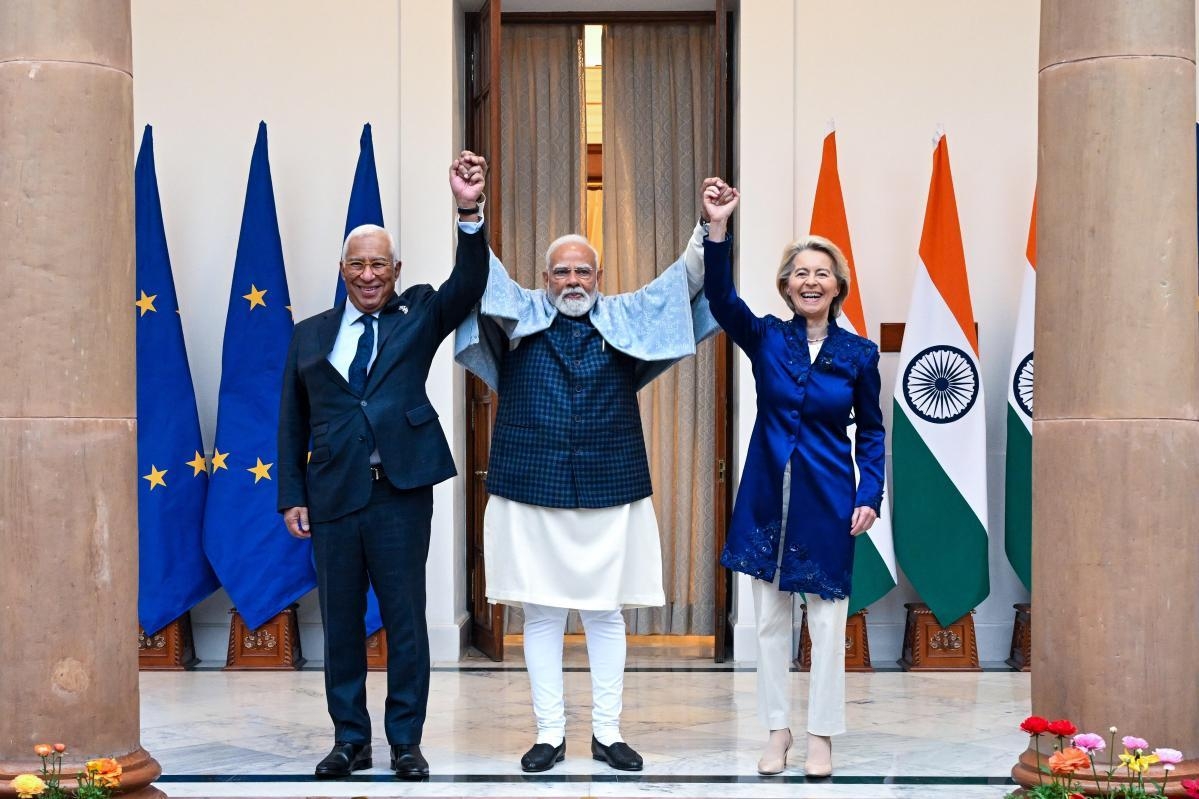
This week’s EU-India free trade agreement (FTA) was less “the mother of all trade deals”, more (as the sexist old joke used to have it) the mother-in-law. But still very valuable.
The EU-India FTA negotiations just signed (after 20 years!) liberalise — fully or partly — 99 percent of Indian exports to Europe and over 95 percent of EU exports to India.
Key service sectors like financial, maritime and corporate transfers are also opened.
While less ambitious than the EU’s previous free trade agreements this remains an impressive achievement given India’s highly-protective tariffs and its historical reluctance to open its market through bilateral agreements.
The Importance of Being Earnest
So what changed? A combination of things. First, Europe — still trying to figure out how to avoid a trade war with Donald Trump, and reeling from its failure to clinch the FTA with Mercosur badly needed a trade success — or face what EU Commission president Ursula von der Leyen described as self-inflicted geopolitical irrelevance.
As Oscar Wilde might have said, to lose one trade agreement is unfortunate. To lose two is careless.
So Europe went into the endgame negotiations ready to trim ambition. The agreement is significant as much for what is not in it as for what is covered.
For a start, initial attempts to foist tough sustainability commitments on India, backed by trade sanctions in case of non-compliance, were clearly a no-go for an India hyper-sensitive to the imposition of “neo-colonial western values” or extra-territorial Brussels effects.
Europe backed down on this in the interests of getting agreement.
This was easier than in the past given recent European backtracking on its ambitious but competition-smothering environmental and climate targets. The Green Deal is so last commission. I predicted this a year or two back.
So pragmatism won out at the end — the sustainability chapter of this FTA is modest, replacing coercion by cooperation, and thus acceptable to India.
No Roquefort in Rajahstan?
A second compromise to clinch a deal was Europe’s agreement to exclude most agricultural products.
India’s heavily-protected dairy sector is untouched (in 2013 I secured a modest blue cheese quota — but that was dropped en route in 2024).
Europe in exchange excluded beef, sugar, poultry and rice from the agreement, all sensitive sectors in Europe.
Even modest concessions to Mercosur triggered violent farmers’ protests on Europe’s streets, contributing to the blocking of the Mercosur agreement.
So apart from dairy producers who were hoping to make modest inroads into the Indian market, and competition from India in niche sectors like Hungarian sweetcorn producers, Europe’s farmers will be happy with this agreement.
Is it compatible with WTO rules to exclude agriculture? Spoiler alert: yes it is.
In any case, both India and the EU have flouted WTO rules in recent years so would not have seen this as obstacle. It is however a bad precedent which will only empower protectionist farmers in Europe.
And India’s calculations?
India, for the first time in decades, found itself in a position of both needing an agreement and having the strength to dictate its terms.
The need comes in part from the slowing of exports to US following Trump’s 50-percent tariff punishment for New Delhi buying Russian oil.
India needs new outlets for its ‘Make In India’ strategy of moving up the value chain, avoiding dependencies in either USA or China.
And with six to seven percent annual GDP growth in the last decade India finally had the self-confidence and sense of its industrial trajectory to expose its economy to more competition — cars, pharmaceuticals, wines and spirits, chemicals, machinery and IT.
So India was satisfied. Commerce minister Piyush Goyal — the ultimate 'Dr No' — found himself in the unfamiliar position of saying yes!
For today let both sides rest on their laurels and celebrate an agreement in principle that is significant both commercially and politically. We know the lead negotiators on both sides and they deserve medals for perseverance and creativity.
Writing for the Atlantic Council this week former US negotiator Mark Linscott provides probably the best, balanced assessment of how valuable this agreement is to each party.
Trumped!
And what does it means for the US? Arguably the best bellwether of the agreement’s value comes from the White House, with US treasury secretary Scott Bessent and Trump criticising the agreement, belittling the bilateral relationship, accusing the EU of undermining US-India negotiations, and railing against European hypocrisy in buying Indian-refined Russian oil.
There is also evident resentment that EU gets first-mover advantage in a potentially massive market and that two billion people are turning their back on an increasingly untrustworthy USA.
Will this EU agreement stimulate the US and India to resume and close their own aborted FTA negotiations? As long as US applies a 50-percent tariff on Indian goods your authos think that India - for reasons of principle - will not come back to the table. Nor should it.
Make In India, or Made in Heaven?
The last big question is whether this agreement signifies a tectonic shift in world trade: the world’s two biggest democracies, the second and fourth economies, asserting common values in the face of a rogue US and a hostile China?
The EU likes to think so.
"Much will depend on the unromantic issue of implementation of the agreement in the next decade"
Or is it a pragmatic transaction to boost the two sides’ respective exporters and investors, giving each side a positive economic narrative to show to Moody’s credit-rating agency, while brushing under the carpet serious political differences — be it India’s support for Russia, the EU’s unquestioning support for the civilisational erasure of Gaza’s Palestinians, the BJP’s persecution of Muslim minorities, and more generally India’s long-standing policy of non-alignment and a very different value set to that in Europe?
As with most foreign policy and cultural issues the truth lies somewhere in between. This author lean to the latter characterisation.
Much will depend on the unromantic issue of implementation of the agreement in the next decade, and not just the international political climate.
Several tricky issues were put aside this week for later consideration such as steel access, procurement, digital rules and emissions trading.
And the paucity of disciplines on Indian sub-federal trade restrictions is a black box that could seriously impede Europe’s expectations for market access across the sub-continent.
Into the long grass?
It is not unusual for trade agreements to be concluded but to postpone some thorny issues.
But in my experience it is risky when political leaders, having reached broad political agreement then say “Our officials can tie up these remaining issues…”.
That approach delayed conclusion of the EU-Mercosur and EU-Mexico deals by two years, because the issues kicked into the long grass are almost always troublesome.
So the plea to both governments is to commit energy and resources to full and faithful implementation in the years ahead.
Set up a continuous dialogue between the governments on both sides.
Rapidly set up structures involving business, NGOs and parliamentarians to keep feet to the fire.
The European Commission has a habit of enthusiastically negotiating agreements — from personal experience it’s the most enjoyable job in the Commission — but gets bored by the prosaic job of implementation, and does not give it necessary resources.
All those monitoring committees. All those time-consuming proposals for development cooperation, dependent on who holds the purse strings; so much implementation put on the shoulders of overworked EU delegations with no particular expertise on procurement or forestry management or customs reform or financial services.
With the India agreement, as with Mercosur in future, both serious resources and high level political commitment must go into implementation.
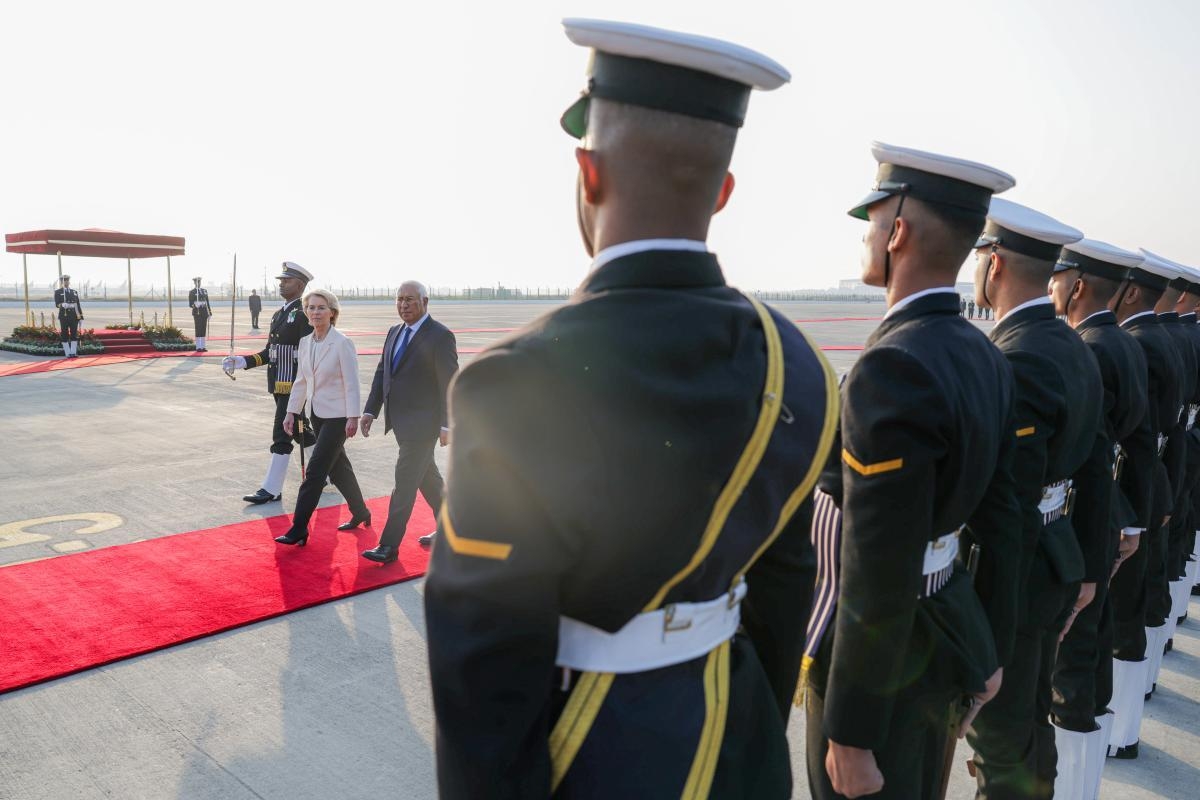
Even after President Von Der Leyen arrives back in Brussels and hangs up her Varanasi silk bandhgala…which, thanks to the FTA, will soon be selling in Europe without a 10 percent duty.
 Russia is likely preparing for a massive autumn mobilisation of over a million soldiers (Ukraine Battlefield update, Day 1,589)