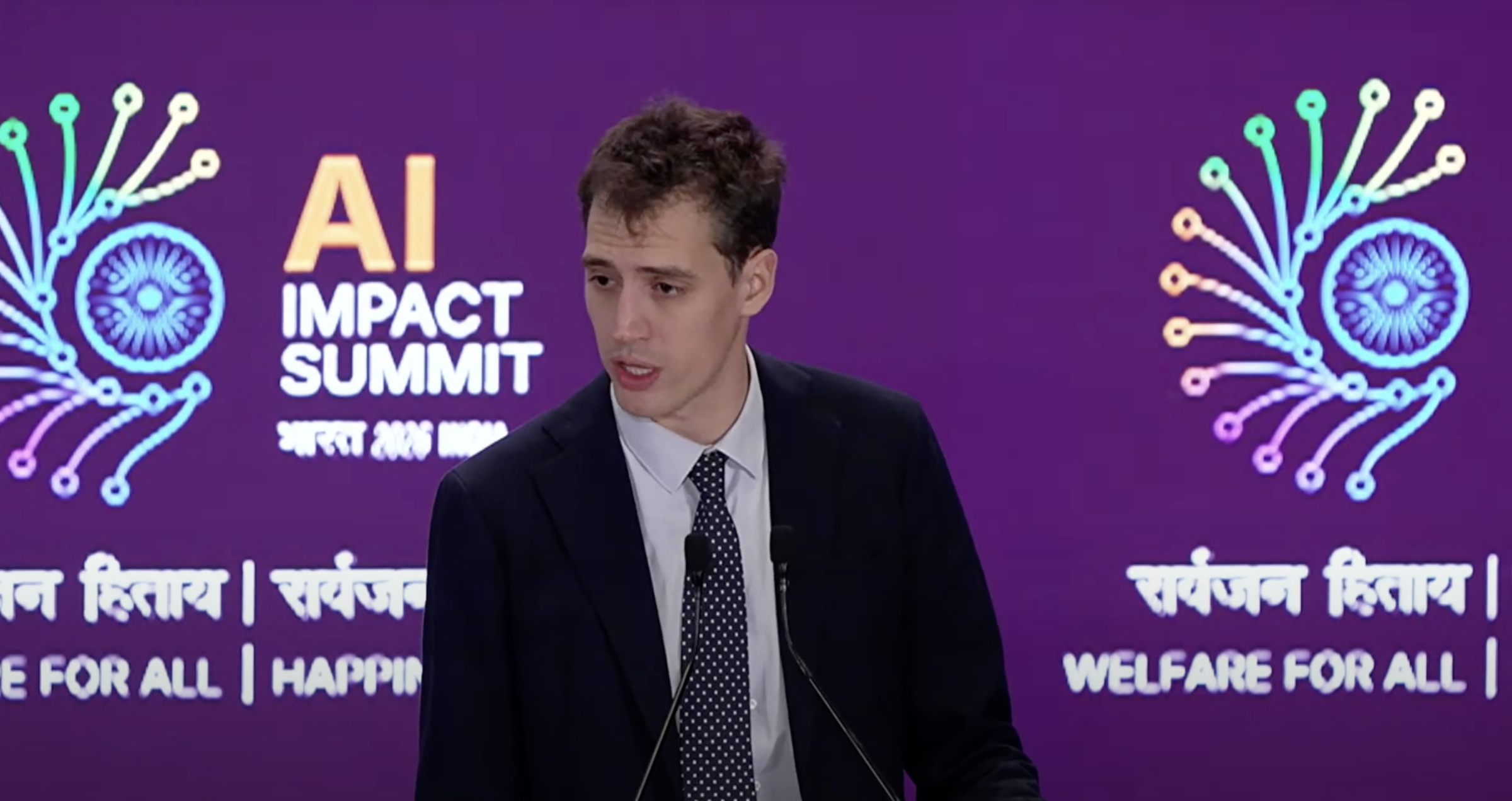
The CEO of Paris-based Mistral, often touted as a European AI champion, raised concerns over the concentration of AI power into a few companies during the global summit in India — while political leaders focused on tech safety.
“I would say that we are at a risk today of facing too much concentration of power in artificial intelligence,” said Arthur Mensch, boss of Mistral, during his speech on Thursday (19 February).
“We don’t want to be in a world where three or four enormous companies actually own the deployment and making of AI,” he warned.
Mensch’s remarks were made during the India AI Impact Summit in New Delhi, a week-long event which has seen world leaders, including some EU heads of state and government, gather to discuss the future of the technology.
The Mistral CEO’s speech stood out compared to other AI business leaders present, including the chief and executives of American firms such as OpenAI’s Sam Altman, Dario Amodei from Anthropic’s Claude, or Google’s Sundar Pichai.
‘Excessive leverage’
In his speech, Mensch worried that the concentration of ownership by a few companies would create excessive geopolitical leverage.
“We need to make sure that every country, every economic community, actually has a strategy to own a part of it [AI infrastructure],” he said.
“It [AI] is going to change the equilibrium in the world. And in order for the equilibrium to remain sustainable and stable, we need to ban excessive leverage,” Mensch warned.
The French company Mistral only has a valuation of €11.7bn (compared to OpenAI’s $500bn [€422bn]), but is investing in open-source, decentralised technology.
The US business leaders did mention the need for democratisation of AI and not creating an “AI divide” in their speeches.
But they were very bullish about their companies’ positions in the global market and the future of AI.
“If we are right, by the end of 2028, more of the world’s intellectual capacity could reside inside of data centres than outside of them,” said OpenAI’s Altman during his keynote.
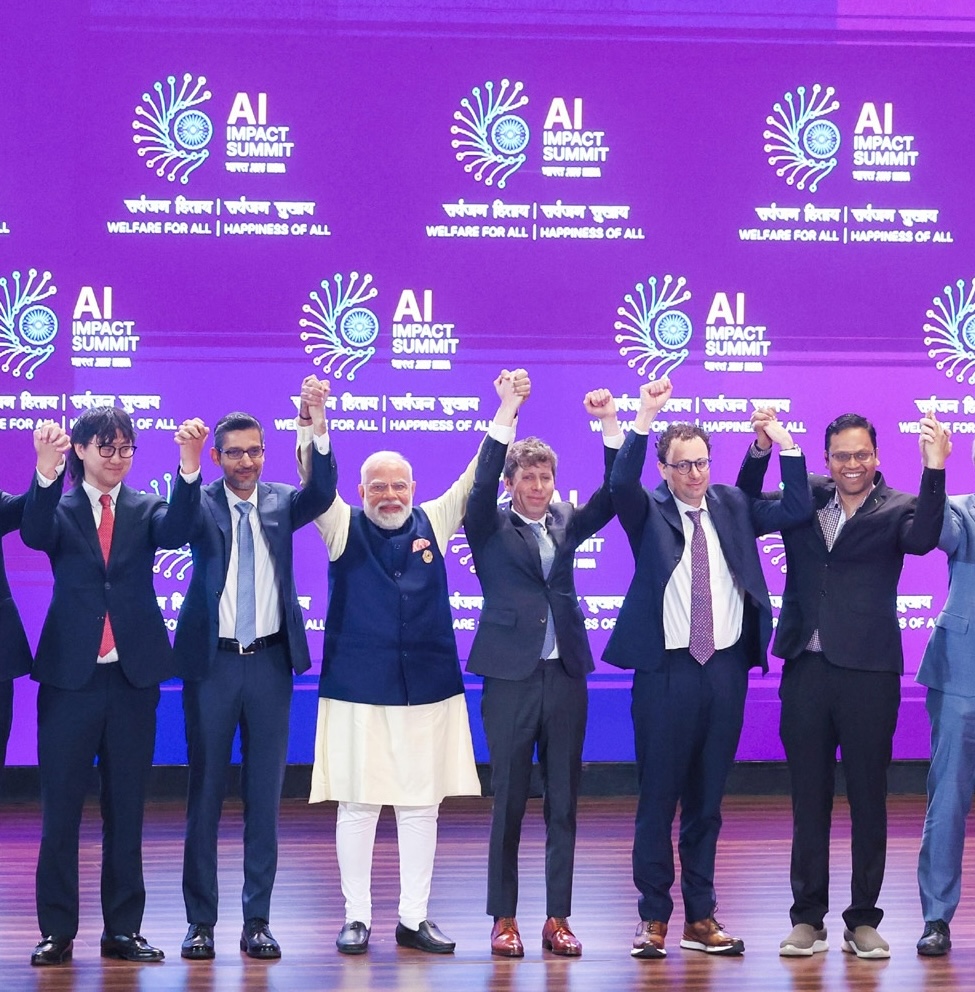
Both Anthropic’s Amodei and Altman also theorised similar grand futures for their companies’ technology, though the competitors refused to hold hands during the photo opportunity — in a sign of the highly-competitive environment in which these companies operate.
Currently, the US tech giants, including OpenAI and Google, dominate the global AI race and infrastructure investment. In India, OpenAI, Anthropic, Amazon, and Google are expanding and investing billions directly in the AI infrastructure.
The US currently holds 74 percent of AI computing power, while China has 14 percent and the EU has just five percent.
For example, one of the most used generative-AI tools in the world, ChatGPT, has around 700 million weekly users, and US Open AI will invest $500bn [€422bn] into AI infrastructure over the next few years.
Macron calls for ‘safe space’ AI
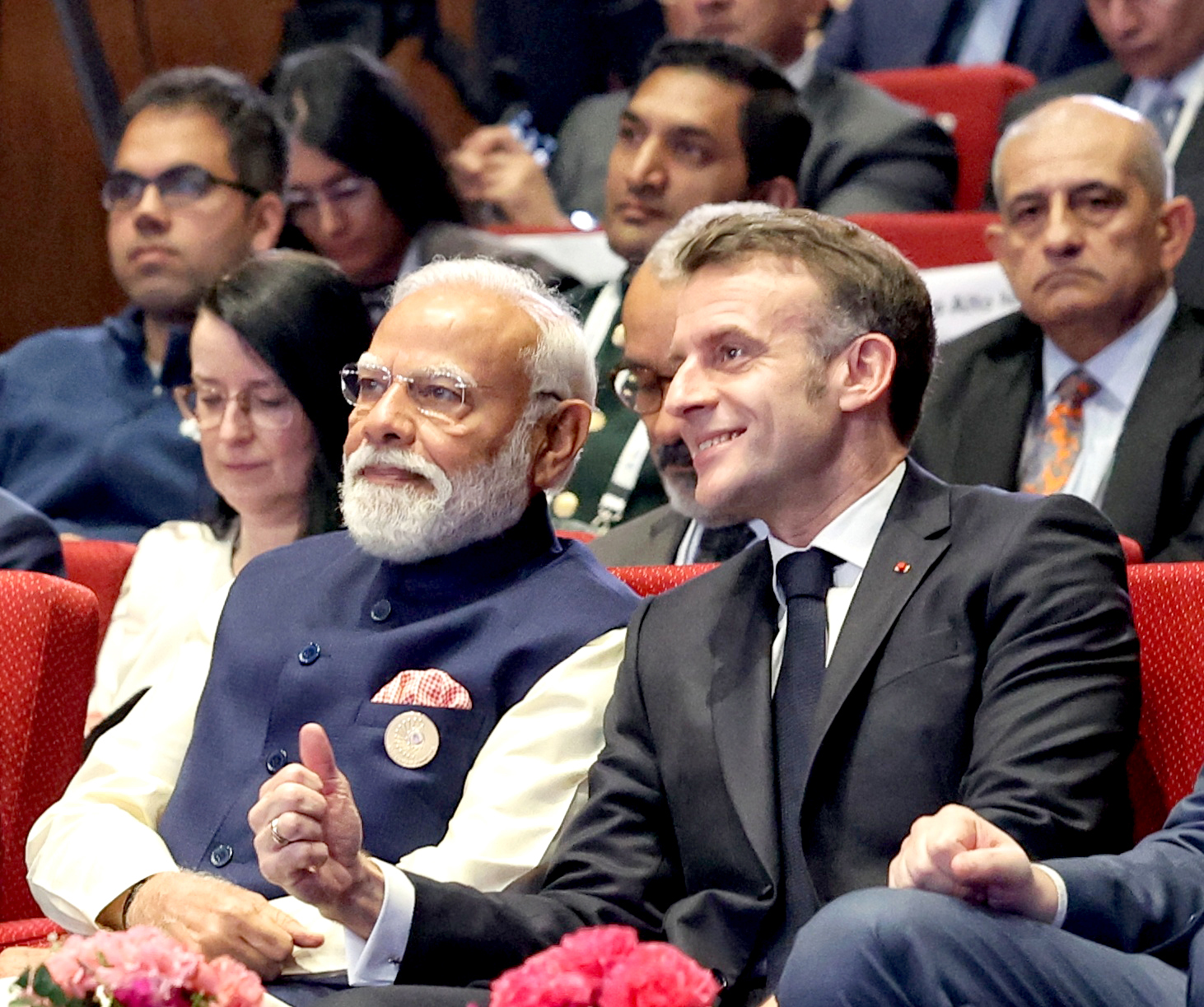
Meanwhile, global leaders at the conference acknowledged the disruptive nature of AI and highlighted the risks related to energy-intensive data centres and safety for users.
“How to make AI human-centric rather than machine-centric, how to make it sensitive and accountable — this is the core objective of the Global AI Impact Summit,” said Indian prime minister Narendra Modi during his speech at the summit.
And Modi outlined India’s vision of the technology, creating an acronym MANAV, which means Human in Sanskrit, calling for the technology to be inclusive, legal, and transparent.
For his part, French president Emmanuel Macron took the opportunity to defend Europe, saying: “Europe is not blindly focused on regulation. Europe is a space for innovation and investment. But it is a safe space. And safe spaces win in the long run”
“The future of AI will be built by those who combine innovation and responsibility. Technology with humanity. And India and France will help to shape this future together,” Macron added.
On Wednesday and Thursday, Modi also met with the EU leaders from Estonia, Croatia, Finland, Greece, the Netherlands, and Spain bilaterally to discuss the relationships between India and the EU nations, along with technological developments.
Spain’s prime minister Pedro Sánchez said during the conference: “We believe in AI for good, but while we believe in technology, we insist that it must be guided by human values. AI should expand human freedom, democracy, rights, not undermine them.”
And multiple EU leaders and Modi took the moment to also discuss the recent EU-India free trade agreement signed in January.

 Smoke from Ukraine airstrike within eyeshot of Kremlin, after Russia hit iconic church (Ukraine Battlefield update, Day 1,573)
 Owen Carpenter-Zehe