“After Orbán here comes another Hungarian nationalist who cannot contain himself. It is clear that the annexation of southern Slovakia to Hungary is still the primary objective of Hungarian politics,” this is how Slovak sports minister Rudolf Huliak commented on Péter Magyar’s fondness for the expression Felvidék when referring to Hungarians in Slovakia, who constitute around 10% of the Slovak population. Felvidék is a historical Hungarian name for parts of Slovakia where the Hungarian minority lives, and is politically sensitive due to its association with pre-1920 borders and the Treaty of Trianon. Magyar’s use of Felvidék has already blown a fuse for Slovak president Peter Pellegrini, and other Slovak politicians.
Concern about Péter Magyar’s nationalist leanings intensified in neighbouring countries after reports that, at the Hungarian parliament’s inaugural session on 9 May, MPs might swear their oath before the Holy Crown — a key symbol of Hungarian statehood, associated with historical continuity and sovereignty. The Crown-proposal originated from the far-right Mi Hazánk Mozgalom but was backed by both Magyar’s Tisza party and Fidesz. In the end, the Crown will not be brought into the chamber, as the Holy Crown Committee — a state body that oversees its use and includes outgoing prime minister Viktor Orbán — did not approve the move.
Péter Magyar also announced that after he takes the prime ministerial oath, not only the Hungarian, but the European, Roma and also the Székely (Szekler) anthem, associated with a Hungarian minority in Romania, will be played.
Alongside the Hungarian and Szekler flags, the EU flag will also be raised on the Parliament building – a flag that the chamber led by László Kövér has not flown for more than ten years.
How did Fidesz become the “national camp”?
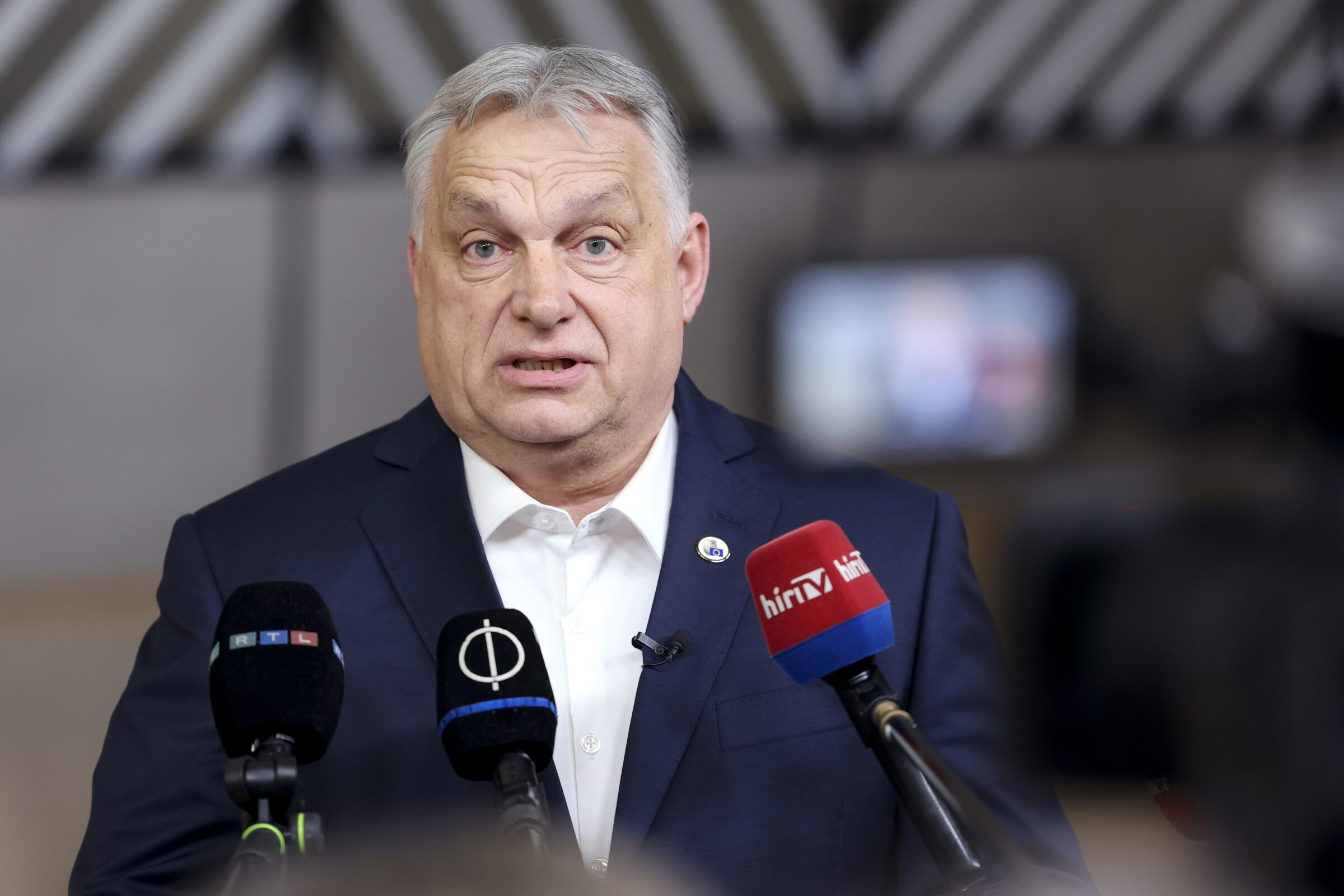
An important part of Fidesz’s rhetoric and politics was that it successfully appropriated national symbols. According to Bulcsú Hunyadi, an analyst at Political Capital, this helped Fidesz to assert (this was still present in Orbán’s language use even after the elections) that they were the “national camp”, representing the Hungarian nation and defending the homeland from external and internal enemies, while those who criticised the government were traitors to the homeland. The entire theme of external interference and the portrayal of their critics as foreign agents was also built on this, Hunyadi adds.
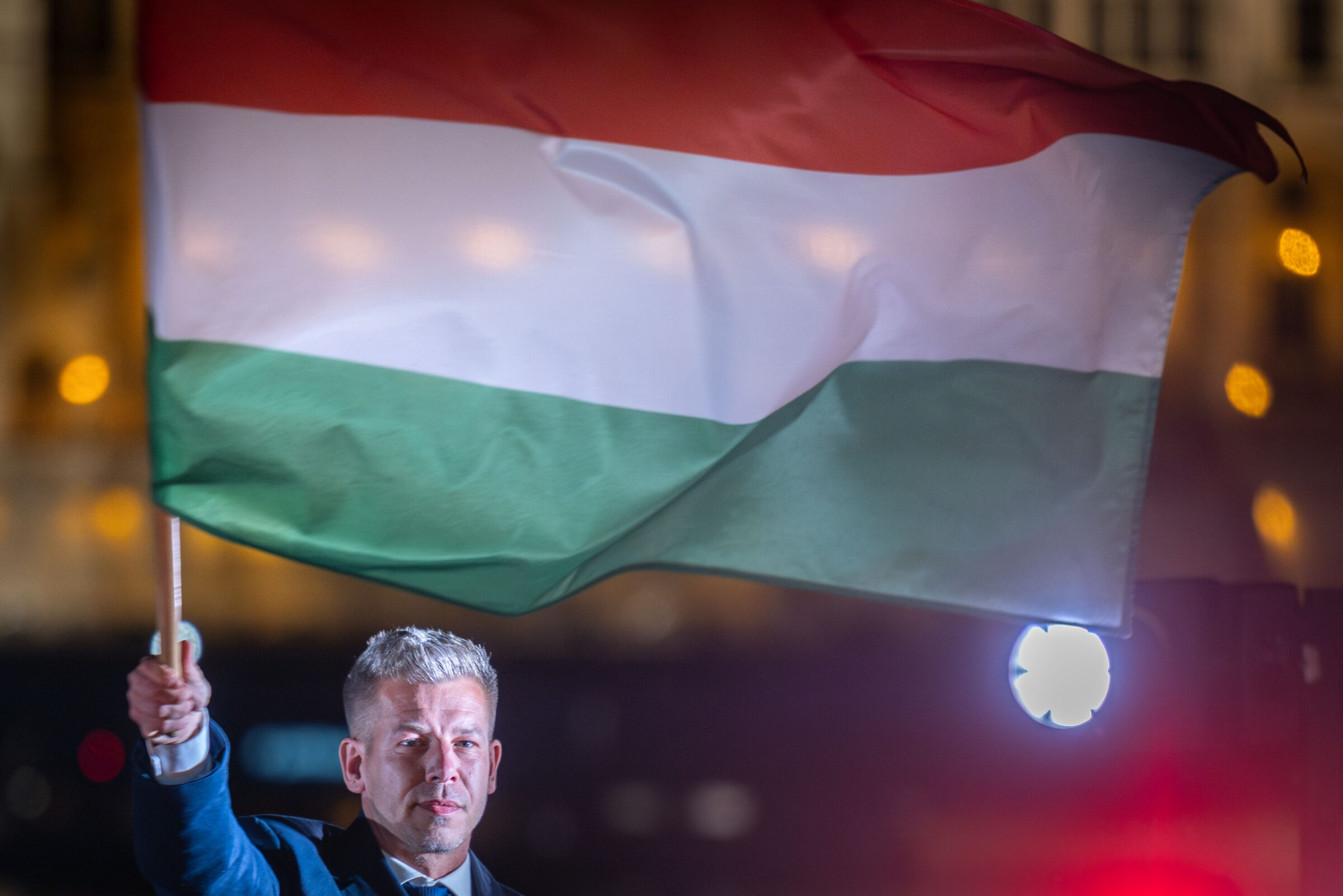
The appropriation of national symbols was also made possible because the former left-wing and liberal opposition parties – most of which have now largely disappeared – did not consider the topic important. In fact, they themselves did a great deal to help Fidesz effective, Hunyadi recalls. The most memorable case was the 2004 referendum on dual citizenship, when then prime minister Ferenc Gyurcsány threw himself into a campaign against ethnic Hungarians living beyond the borders.
Péter Magyar’s turn
Péter Magyar brought about a major shift on this issue. “This was a very important element of his campaign’s success,” says analyst Bulcsú Hunyadi.
Magyar has often stated that he comes from a conservative family and subscribes to a conservative ideology, so he began to use national symbols. “He put Fidesz in a very difficult position, because they could not label Péter Magyar as a liberal or as left-wing, since he comes from the same ideological milieu as Fidesz supporters. Moreover, Magyar did not engage with the other opposition parties.”
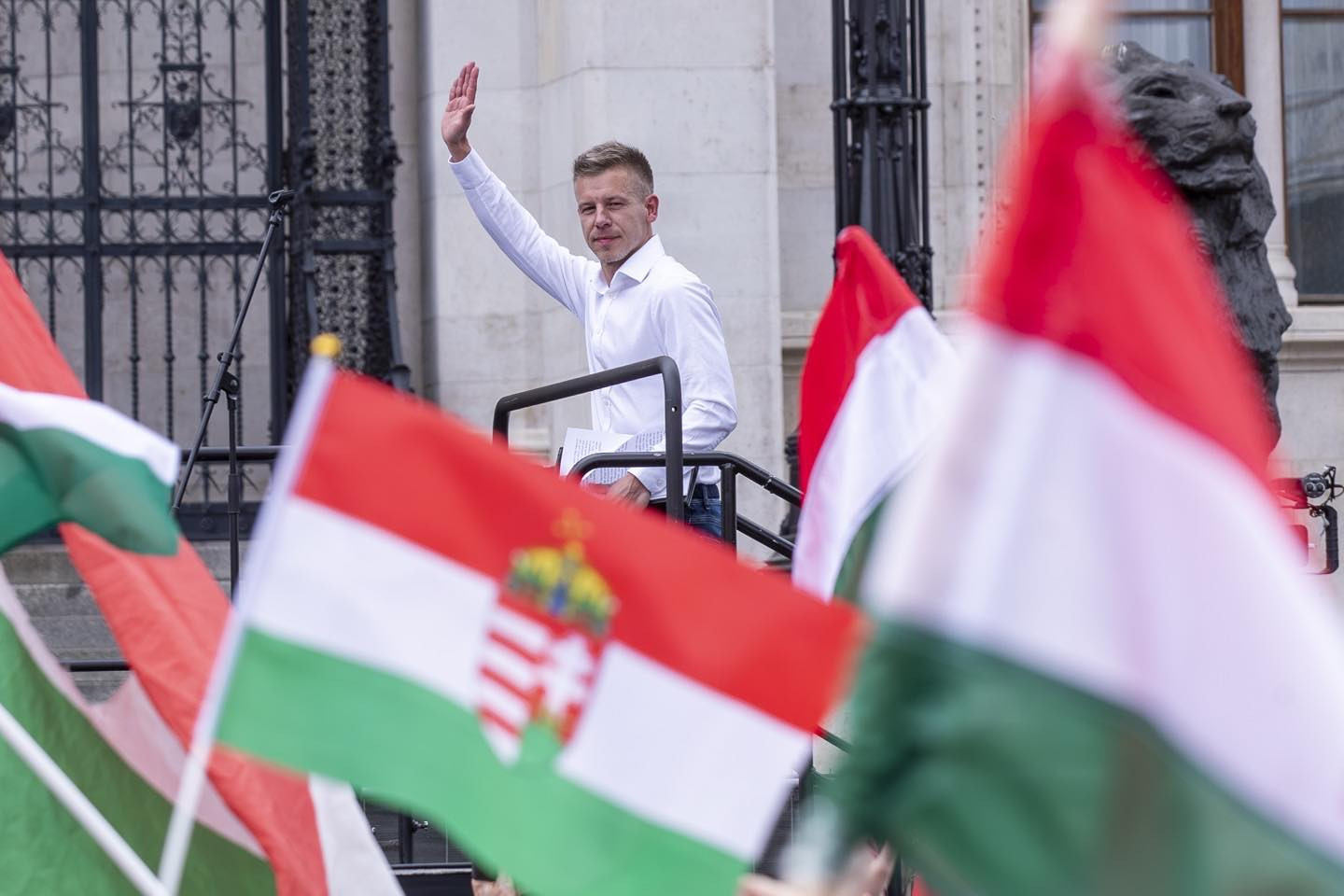
Hungarian flags and folk songs appeared at Magyar’s early events, and he liked to refer to important figures and events in Hungarian history.
It was also memorable when, in March 2025, he appeared in public wearing a traditional-style Hungarian suit, called bocskai.
In May 2025 he set off on a hike from Budapest to Oradea in Romania to send a message to Viktor Orbán, who had supported the anti-Hungarian Romanian presidential candidate George Simion. Marching with his trekking pole decorated with ribbons bearing the national colours, Magyar definitely stepped away from other opposition parties.
After the elections, Tisza’s campaign chief Péter Tóth told Partizán Youtube channel that this journey had changed Magyar more than anything else in the past two years.
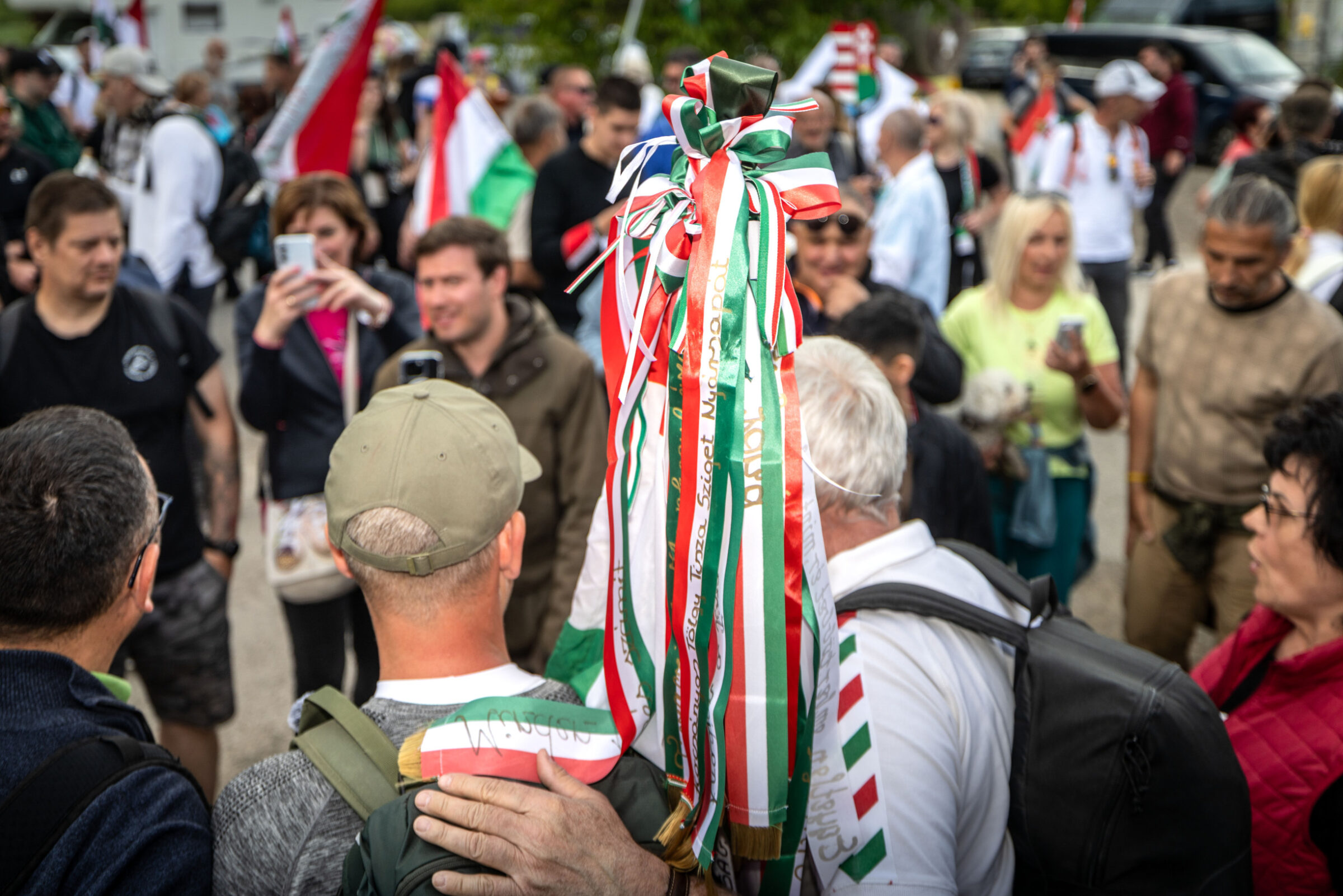
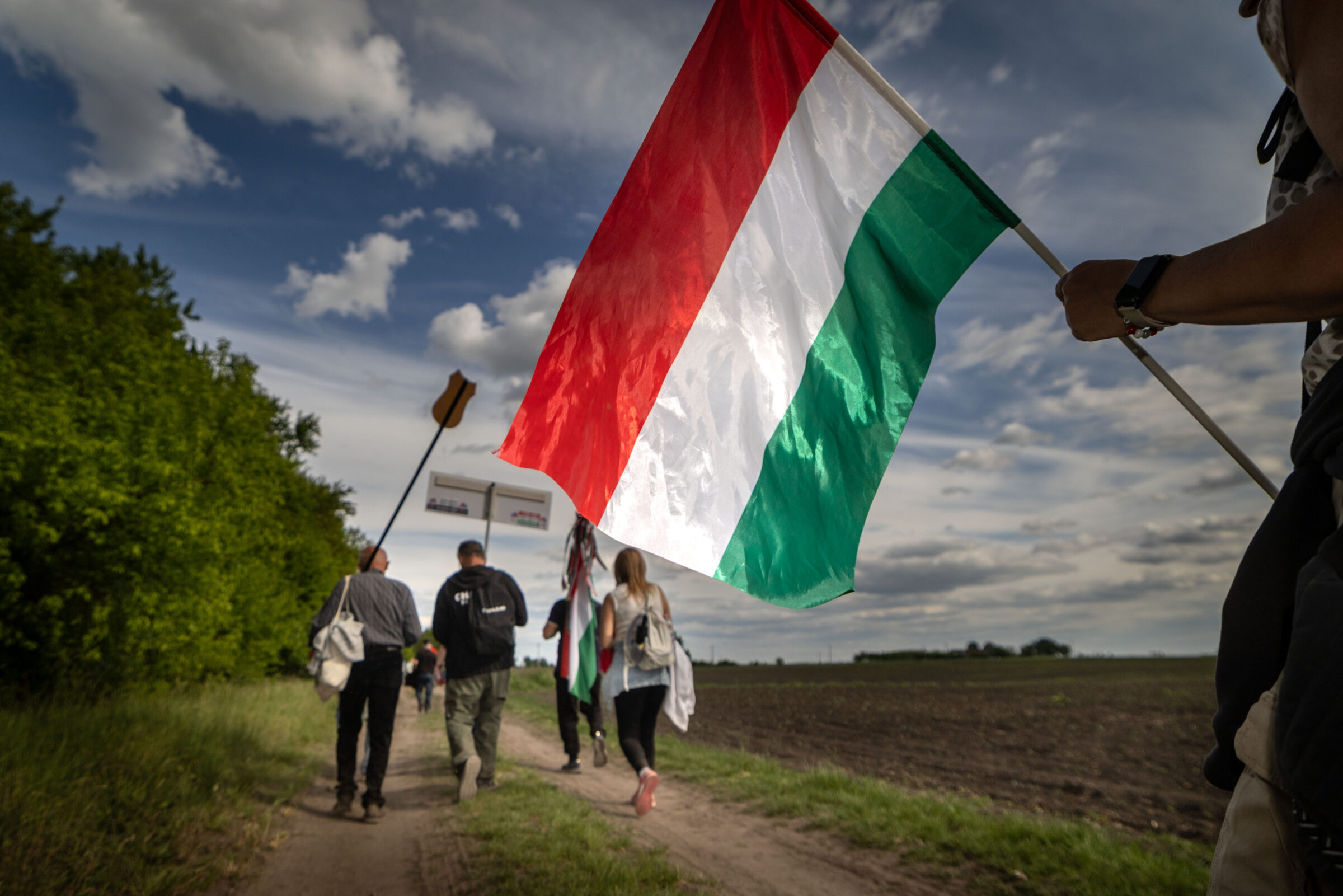
What might patriotism mean for Péter Magyar?
According to Hunyadi, Magyar’s campaign was largely about taking Hungary back.
“He ran a populist campaign in the sense that he talked about three thousand janissaries from whom the country must be taken back. His messages – corruption, the deterioration of public services – were all ones that could be associated with the idea that people are now doing something for their country,” said Hunyadi.
However, the patriotic rapture did not stem only from Péter Magyar. Hunyadi says the enthusiasm that built up around the Tisza leader is also the result of the Fidesz government having suppressed people’s participation in public affairs over the past sixteen years. Many did not dare to get involved in public matters because they feared retaliation. “Now a huge amount of energy has been released in people, which has manifested itself as patriotic enthusiasm. Many also feel that they have got their symbols and their homeland back.”
What is common in the patriotism of Magyar and Orbán?
According to Hunyadi, one shared point is their stance on sovereignty. Both politicians like to stress that outsiders should not interfere in Hungarian politics.
“Fidesz, however, has become discredited on this issue. Information leaked before the elections showed that there is a relationship of subordination between Hungary and Russia. Voters could see in Viktor Orbán’s policy that he was no longer trying to solve the country’s problems, but was playing on a five-dimensional global chessboard, which seemed no longer to serve the country’s interests. By contrast, Magyar focused on problems related to people’s everyday lives, and this, too, is part of his patriotism,” the analyst says.
In Hunyadi’s view, Magyar pays close attention to symbols and in many cases uses them well. Much will depend in future, however, on how the dynamics between Tisza, Fidesz and Mi Hazánk evolve.
“From the point of view of domestic politics, Péter Magyar has to bear in mind that his opposition consists of two right-wing parties. On national issues, it is easy for vulnerabilities to emerge that can be used to attack Tisza, so he will have to find the golden mean.”
On the other hand, Tisza’s voter base is very heterogeneous, with left-wing, liberal, green and conservative groups as well. According to Hunyadi, in selecting his ministers Magyar also tried to make gestures towards each of these camps. “He cannot go too far on questions of national symbols either, if he does not want to lose his non-conservative voters,” the analyst adds.
No objection to Greater Hungary symbols
At his first international press conference after the elections – where, in a manner familiar from Fidesz, he appeared in front of a row of Hungarian flags flanked at each end by an EU flag – Péter Magyar, in response to a question from a Croatian journalist, commented on what he thinks about the use of Greater Hungary symbols. (“Greater Hungary” refers to pre-1920 borders before the Treaty of Trianon, a deeply sensitive issue in central Europe.)
Viktor Orbán’s Greater Hungary scarf and the public use of similar symbols have triggered numerous conflicts between Hungary and its neighbours in recent years.
“We do not deny our past, and we do not deny that we remember our past with affection. We do not deny these thousand years. Obviously, there have been changes to the territorial size of Hungary. There were times when one part did not belong to it, another part did, but this is the map that became widespread. I see nothing objectionable in this. It does not mean revisionism,” Magyar explained.
“We certainly were not flawless, and certainly the other countries are not flawless either, but we should rather look to the future and improve relations as far as possible,” he added.
“We should respect one another. We know full well that Central European history is burdened with many centuries of tensions. And EU or no EU, there will always be flashpoints, since we have all suffered quite serious traumas. But the solution is certainly not to keep calling each other to account, but dialogue, honesty and working through these traumas,” he said a year ago.
Healthy national pride
The reason why Orbán’s Greater Hungary scarf and maps elicited such strong reactions is that Fidesz has been flirting with the far right, says Hunyadi.
“Orbán was a master of double-speak: he spoke to his voters in a way that greatly pleased them, while to everyone else he presented it as if he had said nothing concrete.”
If Tisza uses national symbols but makes clear where the red lines are and does not go anywhere near them, the reactions will not necessarily be as intense, Hunyadi believes.
In his view, a healthy national pride can be expected from Tisza, a sign of which could be the EU flag returning to the parliament building. “The idea of belonging to Europe may be complemented by a nationalism based on national pride, but one that is neither exclusionary nor threatening.”
 THIS WEEK: Angry Trump meets EU leaders at G7 summit, as Ukraine starts accession talks
 Zoltan Szalay