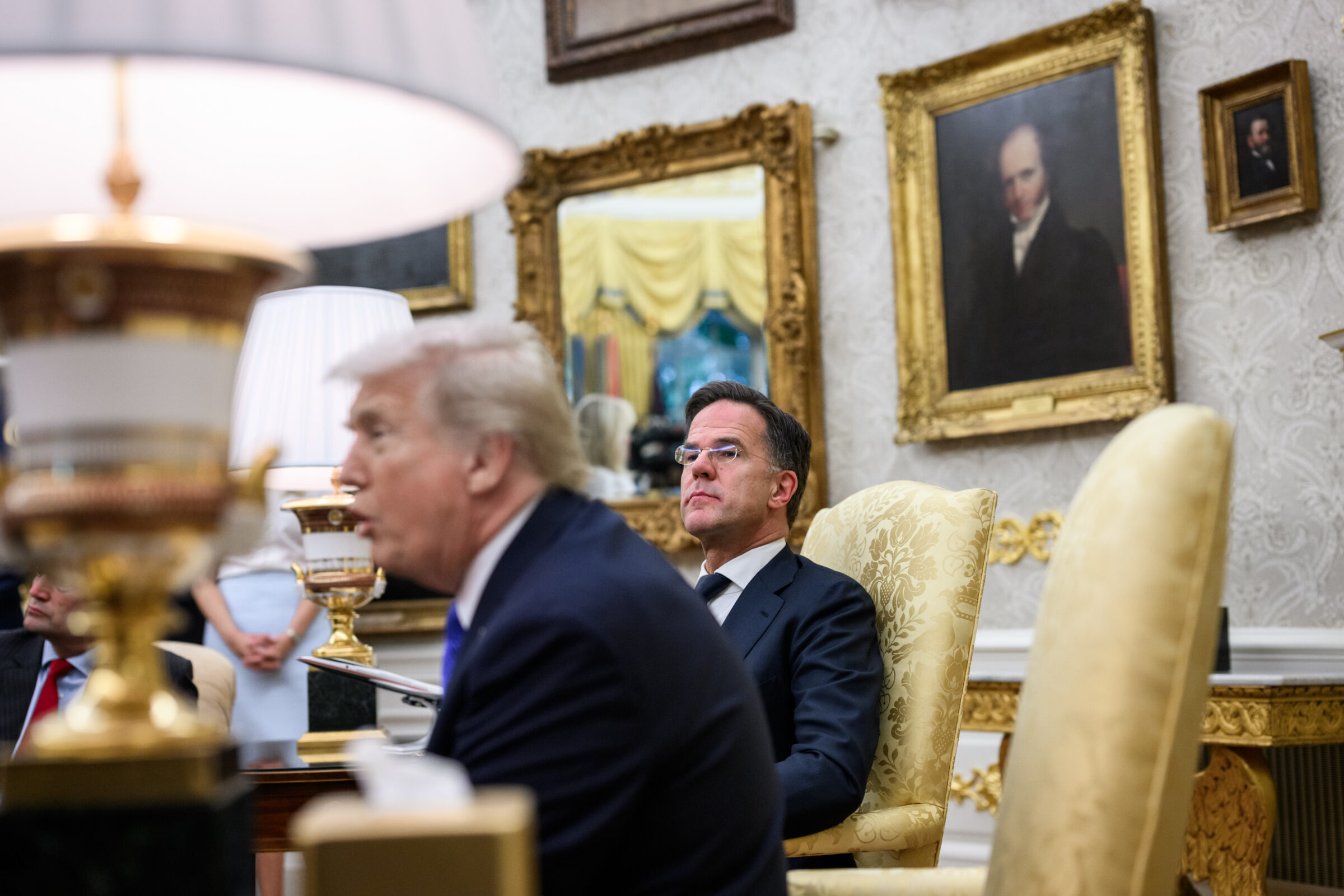
In less than three months, Nato delegations will be packing for the alliance’s summit in Ankara.
The agenda is empty, and the attendance of the most important guest, US president Donald Trump, is unclear. European allies will have time aplenty to ponder their alarmingly short list of security options.
Trump’s decades-old dissatisfaction with Nato has boiled over as its member states steer clear of his botched war in the Gulf.
Washington’s ostensible allies are “cowards” who face a “very bad future” for their “very foolish mistake,” he said, among other insults in recent days.
Though he would need Congressional approval to withdraw formally from the alliance, he says the move is “beyond reconsideration,” adding “I was never swayed by Nato. I always knew they were a paper tiger, and Putin knows that too, by the way”.
Performative disdain is, of course, nothing new in the trans-Atlantic alliance.
For decades, Americans have complained that Europeans spent too little and showed up late or ineffectively. For their part, Europeans have long shuddered at American heavy-handedness or inattention.
But the tone has changed. Finnish president Alexander Stubb, the continent’s top Trump-whisperer, said that US foreign policy has changed fundamentally. His message to allies: “Salvage what you can.”
That is a sharp change of tone; last year, Stubb downplayed the dangers of a trans-Atlantic rift, saying that the alliance could be preserved through calm and reasoned engagement with Washington.
What next?
The question that Europeans face now is 'what next?' Amid endless talk about strategic autonomy — that is, an escape from US hegemony — they have never mustered the money, political will, and unity among themselves to do it.
If Trump has indeed provided the necessary jolt, what would a European-led security system look like? Could it work? How soon would it be ready? And how would the United States react?
For European Nato members (with 600 million people and $30 trillion [€26 trillion] GDP, measured in terms of purchasing power), dealing with Russia (with a population of around 146 million and $7 trillion GDP) is, at least on paper and given time, quite feasible.
After all, much smaller and poorer Ukraine has fought the Russian war machine nearly to a standstill.
For now, however, Europe only provides two-thirds of the deployable capabilities needed for its own defence.
The crucial remainder is provided by the United States, including expensive and hard-to-replicate high-tech systems, such as satellite reconnaissance and battlefield communications.
The European Nato allies also lack mass, with past contingency plans calling for a total of 300,000 US troops, along with American weapons and supplies, to join in the event of a crisis.
Today, the only big army in Europe is Ukraine’s.
The biggest gap is military leadership. In return for its nuclear guarantee to Europe, Washington decides whether any war is fought and how. It runs the main headquarters dealing with Europe, including the Joint Forces Command in Norfolk, Virginia, which is responsible for the Nordic-Baltic region — the most likely target for a Russian attack.
But the current war in the Gulf has shaken European assumptions.
For starters, it exposed the limits of US power. Many of the weapons that the United States would use to reinforce Europe, such as long-range precision strikes and air defence systems, have been used in or are committed to the war on Iran.
Washington and allies in the Gulf fired more than 800 Patriot missiles during the war’s first few days — substantially more than the 600 that were supplied to Ukraine since Russia’s full-scale invasion began in 2022.
The demands of the Pacific theatre aggravate the shortfalls further.
Even before the Iran war, Trump administration sources were floating the idea of a rapid US drawdown in Europe; this could happen as soon as 2027, according to a report leaked to Reuters in December.
Overshadowing the practical questions are the psychological ones.
The great military-bureaucratic edifice of Nato, with all its committees, plans, and exercises, is like an inverted pyramid. Its credibility rests on one decision by one person: the US commander-in-chief.
In the event of a Russian attack on Europe, would Trump choose to go to war with Russian president Vladimir Putin or try to strike a deal with him?
Worse, the US may not just be an unreliable ally but an adversary. European leaders were shaken by US vice-president JD Vance’s rhetoric at last year’s Munich Security Conference, White House threats to annex Greenland, and the explicit support that Trump and other administration figures have given to Hungarian prime minister Viktor Orbán, a pro-Moscow and anti-EU strongman, in the run-up to a make-or-break parliamentary election on Sunday (12 April).
Europe’s decision-makers are also troubled right now by the Trump administration’s unilateral decision to seek rapprochement with Belarus, with a large number of political prisoners exchanged in return for a relaxation of banking, aviation, and other sanctions.
Belarus threat
While visiting Belarus last week, US special envoy John Coale heaped praise on Belarusian autocrat Alexander Lukashenko and the “great value” of his opinion on global issues.
Coale also claimed to be making “great progress” in “reconciling” Belarus and its neighbour Lithuania. Coale added that if the remaining 900-odd political prisoners are freed this year, the US will lift 80 percent of its sanctions.
Humanitarian considerations aside, this sounds ominous.
Belarus is a Russian satrapy and has been the tip of the spear in hybrid warfare attacks against Lithuania, Latvia, and Poland in recent years.
It has weaponised migrant flows by actively bringing border crossers to these countries’ frontiers. Lately, Belarus has sent fleets of balloons into Lithuanian airspace, disrupting aviation and jangling nerves. It has also seized hundreds of Lithuanian trucks.
Allies expect the United States to support Nato and European Union efforts to deter the regime in Minsk from these stunts, not playing nice for reasons that it will not explain.
Some think that the US gambit is a trial balloon for a future rapprochement with Moscow. Others suspect baser motives, such as a deal involving Belarus’s potash industry, which has become newly interesting as the war in the Gulf sends fertiliser prices soaring.
The US gambit is already straining Europe’s internal and external cohesion. Business lobbies in Lithuania and Latvia would love to reopen lucrative transit routes with Belarus. It is not just Putin who plays divide and rule in Europe; Trump likes that tactic, too.
Already, Europe’s divisions — between east and west, north and south, big and small, rich and poor — hamper the development of a comprehensive alternative to Nato.
This starts with the colossal costs of filling the US-shaped gap: at least $1 trillion over the coming 10 years, according to an estimate by the International Institute for Strategic Studies. The EU’s €150bn Security Action for Europe (SAFE) fund is plagued by squabbles and delays. It neither raises enough money nor reforms sufficiently the bloc’s parochial and politicised defence procurement system.
Now, the programme faces competition. The United Kingdom, Finland, and the Netherlands are planning a new multilateral defence fund to borrow money and finance joint procurement. In a decade, that could make a difference.
'Collision-course' with Russia in 2027?
But why would Russia wait? Lieutenant general Roland Walker, a British army chief, wrote in February that Britain and its allies were on a “collision course” with a fast-rearming Russia. He considers large-scale combat operations a possibility as early as next year.


 Are oil markets too optimistic?

 Edward Lucas