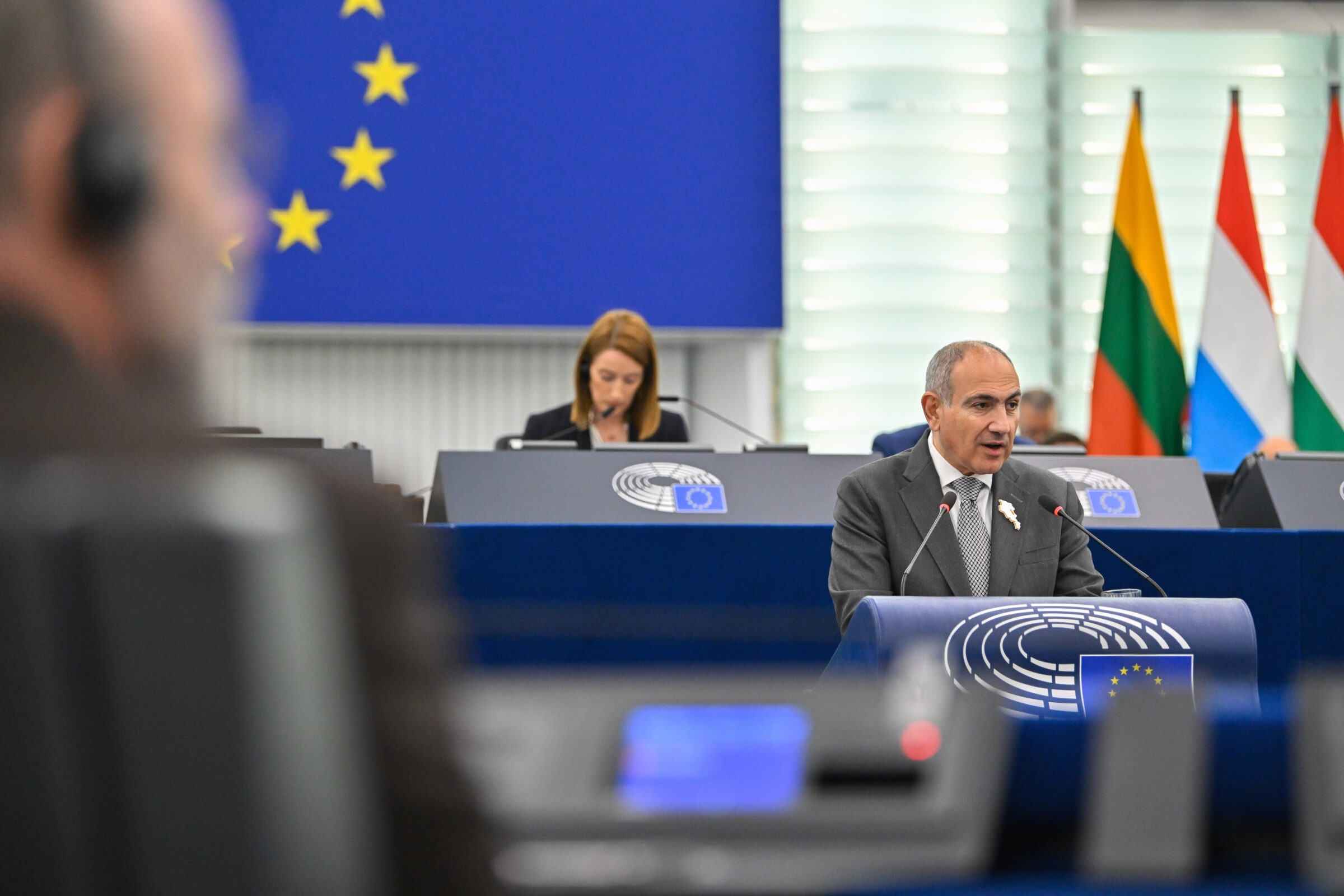
Armenia has warned the EU that Russian-linked forces are using local clerics to try to undermine a US-brokered peace deal with Azerbaijan.
“Today, some are using the altar of Christ to preach conflict, war, and or domestic violence within Armenia,” said Armenian prime minister Nikol Pashinyan in the EU Parliament plenary session in Strasbourg on Wednesday (11 March).
“One of our important tasks is also to ensure that the emotions of our sisters and brothers from Karabakh, who became refugees, are not exploited,” he added, referring to ethnic Armenians who fled the Nagorno-Karabakh region after Azerbaijan reconquered it from Armenia in 2023.
“One of the archbishops in Armenia had started a movement demanding not only to not carry out the [border] demarcation [last year], but also to essentially activate the Karabakh movement, in other words the conflict”, he said.
Pashynian said “certain clergymen who cynically violated all the rules of spiritual decency” had become “agents” of Russia and were “trying to sacrifice Armenia’s independence to the interests of third countries”.
“We will not allow a new conflict or a new war,” he said.
They were being assisted by “some Russia residents and pro-Belarusian oligarchs”, he added.
The same priests, assisted by “lobbyist organisations affiliated with them”, were also spreading disinformation in the EU Parliament “that Armenia is establishing a dictatorship, or Armenia has political prisoners”, he said.
Pashinyan also talked up the benefits of the peace deal he signed in the White House with Azeri president Ilham Aliyev on 8 August 2025.
“2025 became the first year since our independence in 1991, the first year when Armenia-Azerbaijan shootings did not cause – or there were no casualties, no injuries due to Armenia-Azerbaijan shootings,” he said.
And he listed new trade and transport links being built with Azerbaijan as an extra peace dividend.
The Nagorno-Karabakh war in 2023 saw Russian peacekeepers stand by while Azeri forces attacked Armenian ones, leading to a rupture in Armenia’s relations with Russia.
Russia’s full invasion of Ukraine in 2022 also led its neighbours — Armenia, Georgia, and Moldova — apply to join the EU as a form of security guarantee.
And Pashinyan pledged to press ahead with its application process.
But the EU fears that Armenian elections on 7 June could see the Russia-aligned force he spoke of in his plenary address try to unseat him in favour a pro-Kremlin candidate.
“We all know the unprecedented level of threat posed by disinformation and interference to democratic processes,” said parliament president Roberta Metsola on Wednesday.
The EU was planning to dispatch election monitors and experts in hybrid threats, as well as giving Armenia €15m to help fight foreign influence, she said.
Russia has also tried to meddle in elections in Moldova to little avail, but a pro-Russian party in Georgia has seen Tbilisi poison ties with the EU in the past two years, despite pro-EU street protests.
For his part, EU Council president António Costa also visited Baku on Wednesday, in a sign of growing EU engagement in the South Caucasus since the 2023 Armenia-Azerbaijan accord.
"We are … exploring ways to deepen our cooperation in defence and security," he said, despite Aliyev's autocratic rule.
Azerbaijan has also become "central" to EU efforts to buy less fossil fuels from Russia, via its gas exports to Europe through the 'Southern Corridor' pipeline network, Costa said.

 Ukraine’s new French and Swedish jets will pose threat to Russia’s top warplanes (Ukraine Battlefield update: Day 1,605)
 Andrew Rettman