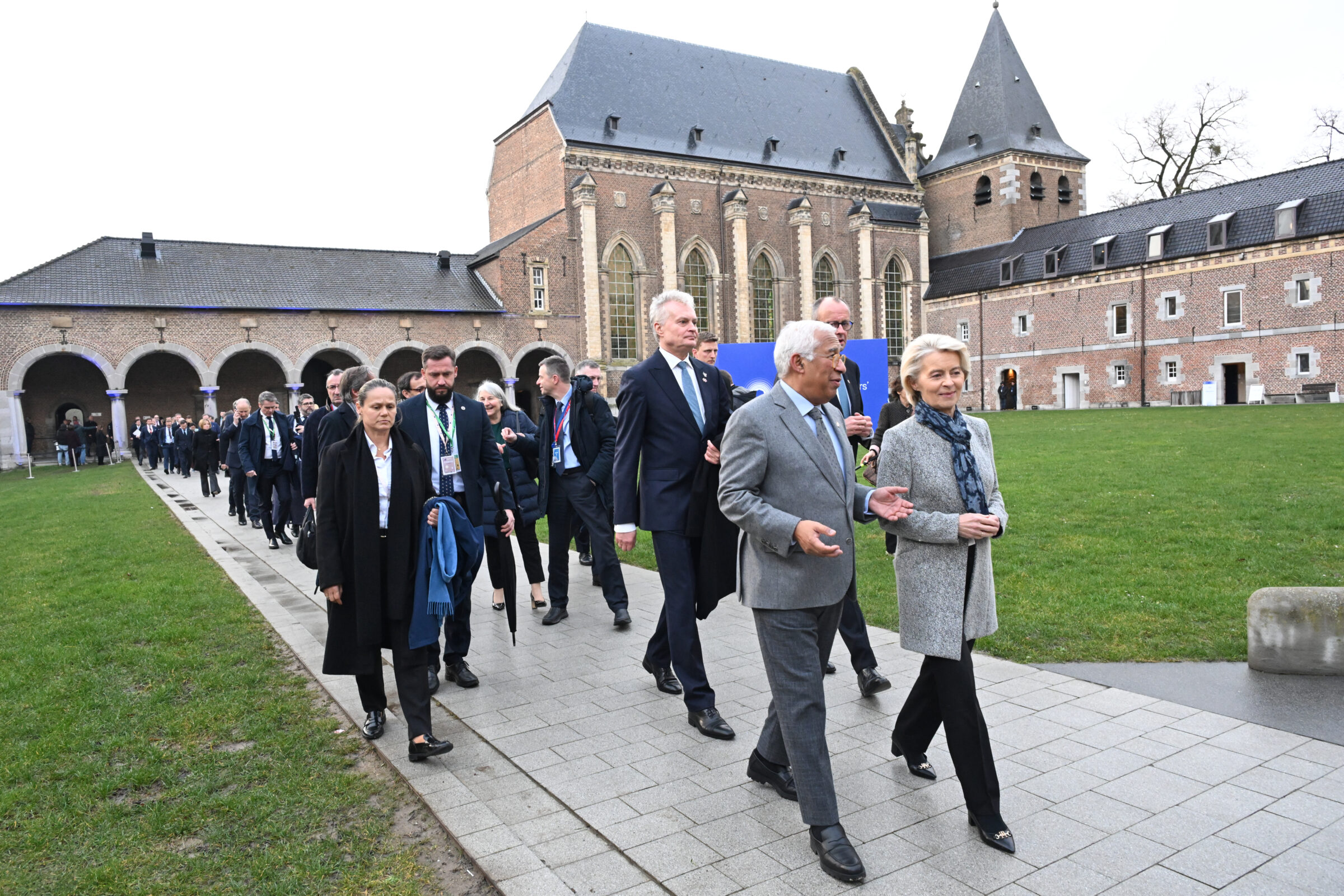
A two‑speed Europe and the so-called ‘European preference’ moved from the margins to the centre of political debate at the EU leaders’ informal retreat in Alden Biesen medieval castle in eastern Belgium on Thursday (12 February).
“One Europe, one market, this was today the headline of the discussion, and this is our ambition,” said EU commission president Urusla von der Leyen, announcing yet another roadmap of reforms needed to boost competitiveness to be presented ahead of the next formal meeting of EU leaders in Brussels in March.
“In 1992, we moved from a common market to the single market; now we are moving from a single market to one market,” said EU Council president António Costa, promising to finalise the process “before the end of 2027.”
“Under pressure we can move mountains,” von der Leyen also said.
Several EU leaders, including von der Leyen, French president Emmanuel Macron and German chancellor Friedrich Merz, have now backed a so-called “two-speed” Europe proposal, which tactically aims to advance reforms by bypassing unanimity — seen as an obstacle to competitiveness in a world shaped by strategic rivalry with the US and China.
The leaders were joined by former European Central Bank chief Mario Draghi and another former Italian prime minister, Enrico Letta, both of whom published reports in 2024 aimed at guiding efforts to make the EU more competitive.
While their reports were released in a different context, before Donald Trump was back in the White House, they were invited to help foster new ideas.
“The only effective response to what Trump is doing to Europe is to integrate the single market and to move from the single market to one market,” Letta said when he left the meeting.
In his 2024 competitiveness report, Draghi estimated annual investment needs at around €800bn — an estimate the European Central Bank (ECB) has since raised to €1.2 trillion a year, reflecting Europe’s expanded defence ambitions.
“There will be no competitiveness without more investment. Our focus today was mostly on how to mobilise private investment,” said Costa, adding that public investment also plays a decisive role, especially in the context of the negotiations of the next EU’s long-term budget.
Pre-summit meeting of 19 states
On the sidelines of the retreat, Italian PM Giorgia Meloni announced that a new working group — led by Italy, Germany, and Belgium, focused on competitiveness — will continue its work ahead of the March European Council meeting.
The meeting was attended by 19 countries – Spain, Portugal, Ireland, Slovenia, Malta and the three Baltic states did not attend.
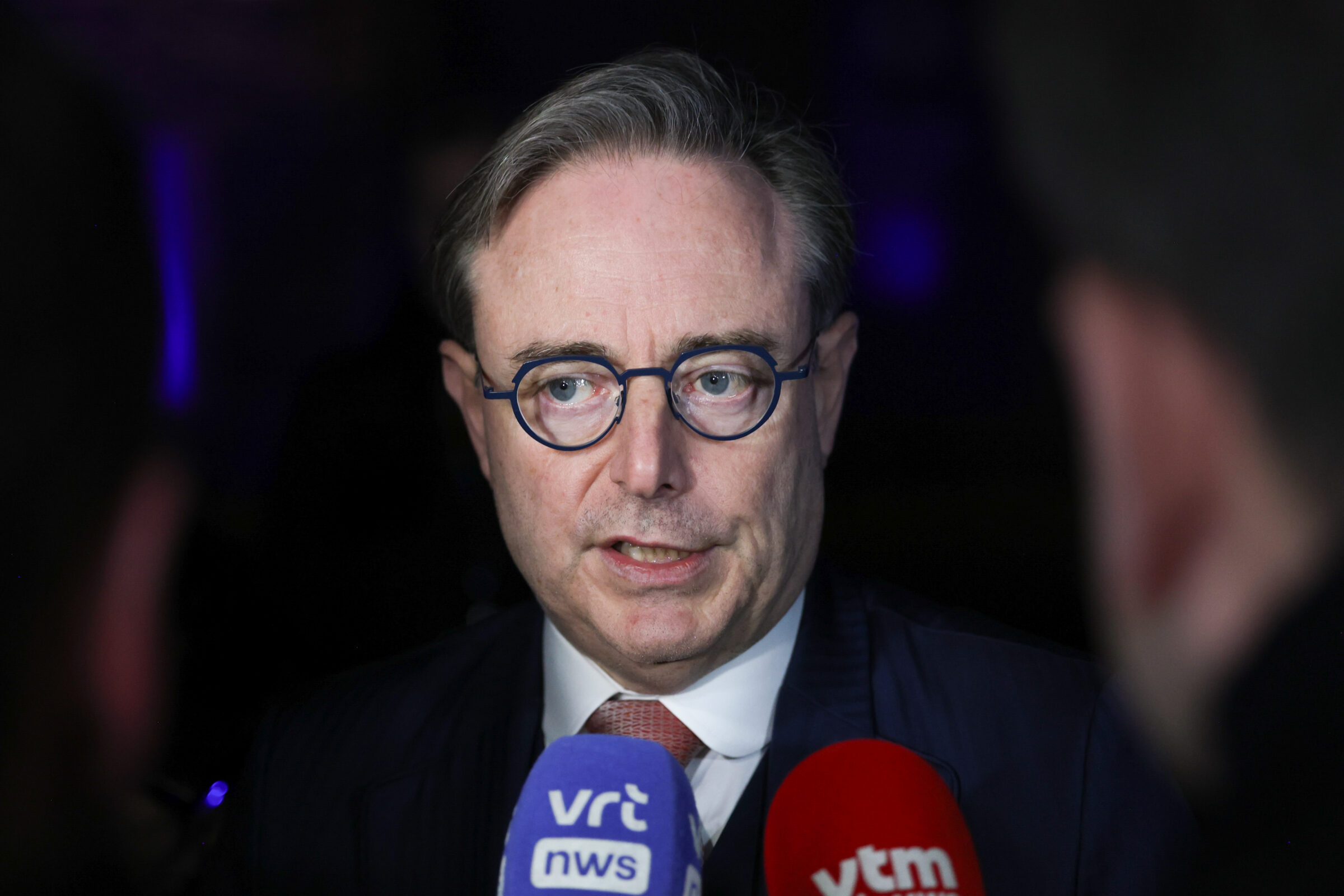
“Everyone was invited to join the group,” said Belgian PM Bart de Wever when the meeting finished, acknowledging that while it may have looked like a “pre-meeting” that was not very “elegant” towards the others, they did not want the perception of a large bloc trying to impose its will on other countries.
“The discussion focused on the three priorities outlined in the guidance document prepared by Italy, Germany and Belgium: completion of the single market; regulatory simplification and reduction of energy prices; ambitious and pragmatic trade policy,” said Meloni on X.
Two-speed Europe
Originally aimed at deepening EU capital markets, the long-stalled Banking Union and Capital Markets Union (CMU) have now been reframed to drive growth and mobilise long-term savings.
Progress on the CMU has been stalled for years, given the list of reforms, ranging from supervisory centralisation and tax alignment to market infrastructure and insolvency changes, while national divides and competing financial interests have only deepened the deadlock.
But there is hope that the CMU, now rebranded as the Savings and Investments Union (SIU) with a focus on savings and investment, could finally gain traction.
On Wednesday, von der Leyen warned that if member states do not advance the long-awaited Capital Markets Union (CMU) this year, she will move ahead with a smaller coalition of countries.
“The completion of the Savings and Investment Union [rebranding of the CMU] can unleash up to €470bn of investment,” she said.
She reiterated on Thursday that if sufficient progress is not made by June 2026, other options will be considered. “Get me right. I prefer doing this by 27,” she said, adding that the option exists for “at least nine member states, if they want to move forward faster.”
“Often we move forward with the speed of the slowest, and the enhanced cooperation avoids that,” von der Leyen said.
28th regime to be unveiled in March
Intra-EU trade has declined, with goods trade dropping from 23.5 percent of EU GDP in 2023 to 22 percent in 2024, signalling fragmentation within the single market.
In fact, the International Monetary Fund has estimated that internal EU barriers are equivalent to tariffs of 44 percent for goods and 110 percent for services – a figure frequently cited by EU leaders, though some experts question its accuracy.
One of the supposed solutions is the commission’s simplification agenda, which critics say risks deregulation, lowering standards that protect health, the environment, workers and citizens’ participation.
Another of the issues discussed on Thursday by leaders was the so-called 28th regime, which would treat the EU as one market for company registration and labour, putting an end to a patchwork of 27 different national rules that are seen as an obstacle for attracting capital, scaling-up and cross-border activities.
The 28th regime, seen by many as a potential ‘game changer’, is expected to be unveiled before the end of March. “Wherever you are, you can set up an EU-incorporated company within 48 hours,” von der Leyen said on Thursday.
If not all 27 member states agree on implementing the plan, a select group could move forward, she also said.
“I will work to avoid ‘enhanced cooperation’ [ie a smaller group of willing states] and to ensure that all the 27 member states agree on the common regime,” said Costa. “We need only one regime to boost the capacity for our companies to work across our market”.
Meanwhile, Macron also hinted at a potential agreement on the reform of merger rules which would help companies scale up and “to make it easier for great European champions to emerge in this international competition.”
The 27-nation bloc produces many startups, but few turn into big players, with a few expectations including Dutch semiconductor ASML, Germany’s SAP, Sweden’s Spotify or Denmark’s Novo Nordisk.

‘Made in Europe’
Similarly, discussion over a so-called “European preference” or “Made in Europe” regime, which would favour domestic companies in strategic sectors, is being carefully calibrated by the European Commission to avoid projecting protectionism or retaliation from trade partners, while complying with international trade rules.
The commission is leaning toward a flexible interpretation of “European preference,” aligning more with Germany than France.
A draft Industrial Accelerator Act proposes favouring products with local content in public procurement, but allows exceptions for “trusted partners” that meet reciprocity and competitiveness criteria. France wants a strict limit to European Economic Area countries, while Germany favours a broader “Made with Europe” approach, including trade partners and like-minded nations.
According to Costa, leaders agreed on the need to protect strategic industries, including AI, quantum technologies, payment systems, defence, space, and clean tech. “We will map and identify our dependencies and address them through a diversification strategy based on European preference, applied in selected strategic sectors,” he said.
“I feel that there is a good agreement on the need to use it in the selected strategic sectors in a proportional and targeted way, after the in-depth analysis to identify where it is necessary and useful,” said Costa.
Energy prices
Facing pressure from parts of industry and several leaders to lower energy prices, and even scrap the EU’s emissions trading system (ETS) altogether, von der Leyen pledged that a July review would examine whether the carbon pricing system needs “elements” capable of modulating prices if costs rise too much.
She strongly defended the scheme, however. Since 2005, emissions in ETS-covered sectors have fallen by 39 percent, while other sectors have grown by 71 percent.
“Decarbonisation and growth can go hand-in-hand,” she said. “If you want to pollute, you pay. If you do not want to pay, you innovate.”
On energy market design, von der Leyen said leaders had “an intense discussion” and that the commission would present “different options” in March, including possible changes to the merit-order system, under which expensive gas often sets the electricity price for all, even when most power comes from cheaper renewables.
“Industrial policy is clearly top-tier in the EU … [but with] clear differences between France pushing the EU debt as an investment booster, and Germany with focus on red tape and ETS,” said Marcin Korolec, Green Economy Institute director, and former Polish climate minister, reacting to Thursday’s leaders’ discussions.
 EU’s ‘Voldemort’ problem: talking about China without mentioning China
 Elena Sánchez Nicolás
 Wester van Gaal