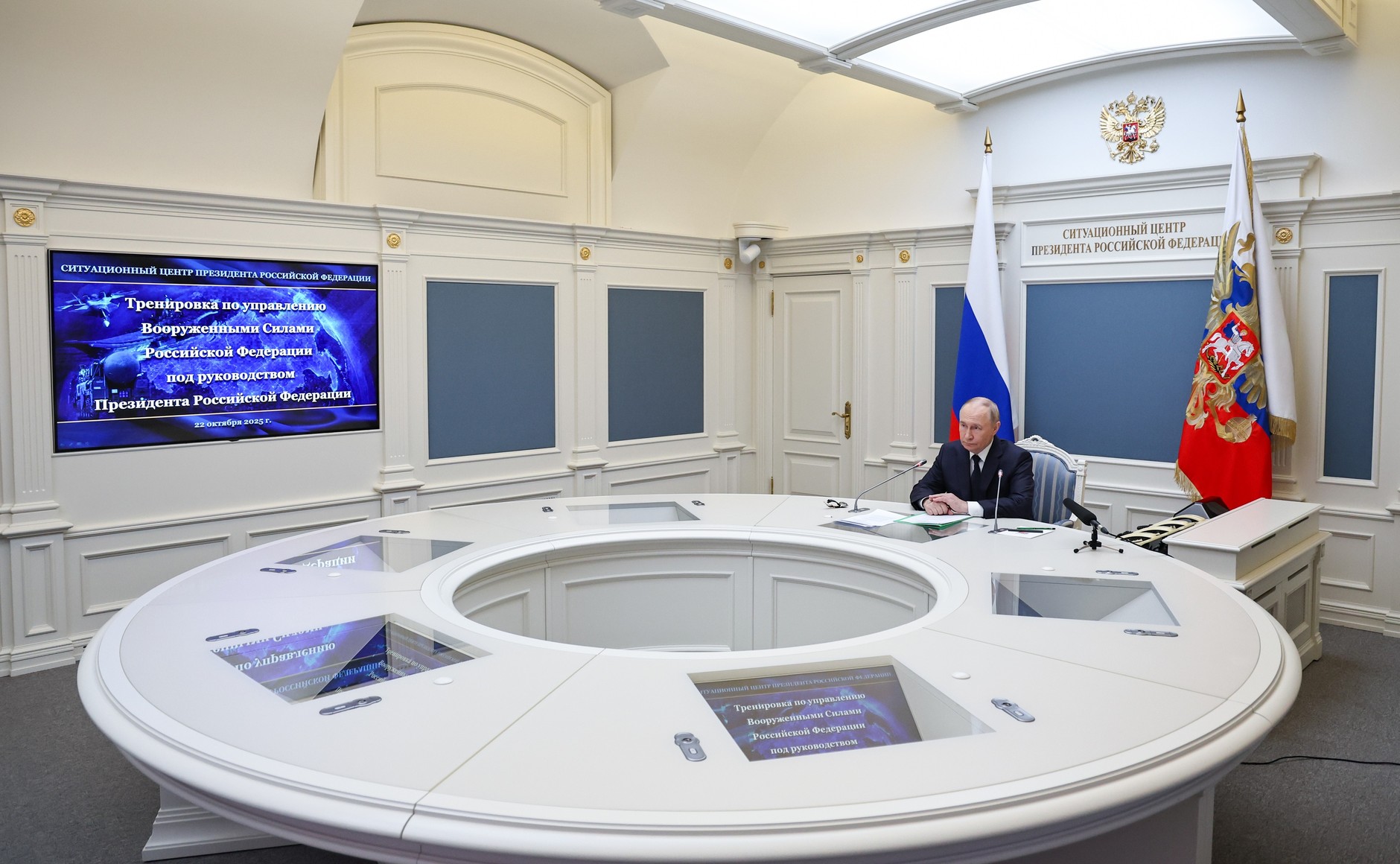
The risk of a small Russian nuclear strike in Europe is rising as the US military deterrent wanes, a British think-tank has warned.
“Russia could conduct a successful limited ground incursion into European Nato territory and still maintain escalation dominance, as long as the US refuses to actively contribute to European defence,” said British defence think-tank, the Royal United Service Institute (Rusi), in a report out on Thursday (29 January).
“Should Russia find that it has miscalculated and that it is confronted by the prospect of unacceptable losses in a conventional conflict in Europe, Moscow may resort to the use of limited nuclear strikes against Nato territory,” it added.
“It is mainly the expected US shifts in its conventional, rather than nuclear, posture which are driving these concerns. There is currently no sign that the US will decrease its extended nuclear deterrence commitments to European Nato members,” it also said.
But US president Donald Trump’s threats to seize Greenland by force “mean that changes in US extended deterrence in Europe also cannot be ruled out,” it warned.
The study cited estimates that Russia could be ready for a limited European attack between 2027 and 2030.
European Nato forces had air-power superiority, but Russia had “quantitative” superiority in infantry and ground forces, drones, and long-range missiles, according to Rusi.
The UK and France also have some 515 nuclear warheads together.
But the UK nuclear arsenal is not “sovereign” from the US, meaning that if Trump turned his back on Europe, the independence of the British nuclear power was unclear.
The French nuclear force is not integrated into Nato, and French nuclear doctrine makes it unlikely to be used to protect far-flung allies, such as Poland, instead of being used only in an “existential threat” to France.
Both the UK and France also lack the small-scale “tactical” nuclear weapons that the US and Russia have in abundance, making it harder for them to respond to a tactical Russian strike in Europe with anything other than a general strike against Moscow — triggering mutual destruction.
“Without the backstop provided by US nuclear forces, the UK and France currently lack the flexibility of response – in capabilities and doctrine – to credibly deter or respond … [to] limited Russian nuclear use in Europe,” Rusi said.
Rusi advised “frontline” EU countries to invest in more high-tech conventional weapons – such as long-range, US-made ‘Dark Eagle’ and ‘Typhon’ systems, as well as air-defences, and anti-submarine capabilities – to make Moscow think twice.
Nato should also hold more joint nuclear-conventional exercises, such as 2025 Steadfast Noon, which included non-nuclear Finland and Sweden, to demonstrate resolve.
Meanwhile, “the UK and France will need to assess how to make their nuclear deterrents fit for purpose”, via deeper bilateral cooperation in the nuclear arena, and development of tactical systems.
For her part, EU foreign affairs chief Kaja Kallas, who comes from ‘frontline’ Estonia, echoed Rusi’s thinking in a speech at the European Defence Agency in Brussels on Wednesday.
“The US will remain Europe’s partner and ally. But Europe needs to adapt to the new realities. Europe is no longer Washington’s primary centre of gravity,” she said, speaking of the US pivot toward China-deterrence instead of Russia.
“As the US is setting its sights beyond Europe, Nato needs to become more European to maintain its strength,” she said.
And as the Russia-China alliance deepens, there was a risk “that China and Russia could coordinate their aggression to intentionally stretch US responses,” Rusi also said, speaking of a potential Chinese attack on Taiwan in concert with a Russian attack on a Nato state in Europe.
Meanwhile, Nato secretary-general Mark Rutte voiced greater confidence in the US commitment to European defence in remarks in the EU Parliament in Brussels on Wednesday.
But he also warned Europe was “dreaming” it could fend off a conventional Russian attack without US support, while adding it would cost too much to manufacture its own “nuclear umbrella”.
A US defence strategy paper published on 23 January said “although we are and will remain engaged in Europe, we must — and will — prioritise defending the US homeland and deterring China”.
The Pentagon also said it will “calibrate” its force posture in Europe to align to its priorities, in a sign that some of the 80,000 US soldiers stationed in US bases here will be going home.
Doomsday Clock
The Chicago-based non-profit organisation, the Bulletin of the Atomic Scientists (BAS), also warned on Tuesday the world was closed than ever to a nuclear war, by moving its ‘Doomsday Clock’ four seconds closer to midnight than last year.
“In terms of nuclear risks, nothing in 2025 trended in the right direction,” BAS head Alexandra Bell told the Reuters news agency.
“Longstanding diplomatic frameworks are under duress or collapsing … [and] there were three military operations taking place under the shadow of nuclear weapons and the associated escalatory threat,” she said, referring to clashes in Ukraine, Iran, and India/Pakistan.
“A shift towards neo-imperialism and an Orwellian approach to governance will only serve to push the clock toward midnight,” she said.
The last nuclear non-proliferation treaty between the US and Russia – called Start – also expires on 5 February.
“If it expires, it expires,” Trump told The New York Times newspaper on 8 January.
Become a subscriber and support EUobserver’s journalism in 2026.
 Andrew Rettman